
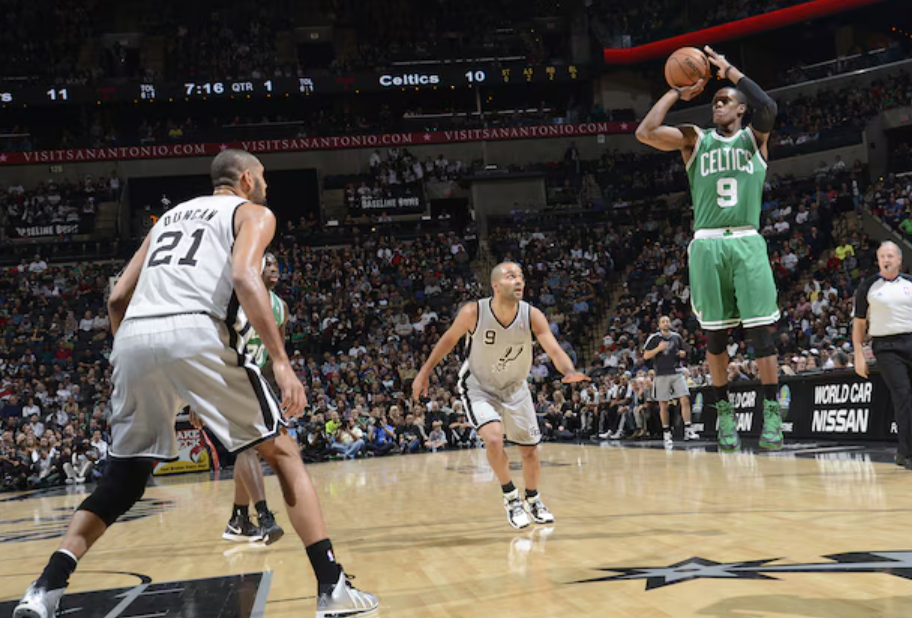
There’s a specific type of player that defenses love.
Not the bad shooter. Not the slow guy. The hesitant one. The player who has the skills, has put in the work, and then gets into a game and decides that today is not the day to test any of it. Defenses don’t need a scouting report on that player. They just stop guarding them and go help on everyone else.
If that sounds familiar, this one’s for you.
The Math Is Not on Your Side
Let’s talk probability for a second because it makes the hesitation look even worse than it feels.
The best shooters in NBA history make around 40% of their threes. The best mid range shooters in the league hit somewhere in the low to mid 50s. Those percentages are built on thousands of attempts over entire careers. They are not built on three shots a game.
If you take three shots a game and miss them all, you’re shooting zero percent. If you take three shots a game and hit one, you’re shooting 33%. Neither number means anything because the sample is too small to tell you anything real. You need volume before percentage becomes useful information. You need to give yourself enough attempts that the math can actually work in your favor.
Think about it this way. In a solo workout you might miss ten or fifteen in a row and not think twice about it. You know your percentage is fine and that it’ll even out. Three shots in a game is you quitting after ten misses and writing yourself off. The only difference is the jersey.
[search: NBA shot attempt leaders stats volume scorers]
What Happens to the Defense When You Don’t Shoot
This is the part nobody thinks about enough.
When you’re not a shooting threat, the defense gets a free player. That defender can leave you, sag into the lane, help on every drive, and make life genuinely difficult for your teammates. You have essentially donated a defender to the other team. Free of charge. Very generous of you.
Draymond Green and Rajon Rondo are the cautionary tale here. Both incredibly intelligent players. Both made entire careers work without being shooting threats. Both also played their entire careers with defenses that could ignore them from distance, which made everything harder for their teammates and required their teams to build around that limitation very carefully. Most players don’t have teammates good enough to make that work. Most players just become someone the defense forgets about.
[search: Draymond Green defense sag off no shooting threat]
Now flip it. Think about any player who gets face guarded the entire game. Klay Thompson off screens. Steph Curry coming around a pick. Any shooter a defense absolutely cannot leave open for a half second. Those players don’t even need to score every possession to be effective. Their presence alone collapses the defense, opens driving lanes, and creates easier shots for everyone else. They are a threat by existing on the court.
You get to be that by shooting. Not by being Steph Curry. Just by being someone the defense has to think about.
The Practice Player Problem
I’ve worked with more hesitant shooters than I can count. The pattern is almost always the same. Skills are there. Confidence in practice is fine. Games feel different for reasons they can’t fully explain, so they play it safe, which means they play invisible.
One player I worked with in middle school is now in high school and almost unrecognizable from a confidence standpoint. He could shoot. Always could. But in games he was passive, looked to pass first always, and basically disappeared from the offense for stretches. We spent time in training specifically pushing him into harder situations so he could see that his skills held up under pressure. Contested shots. Timing. Defense closing out. He kept making them.
Something clicked. Now his coach has the opposite conversation with him, reminding him to run the offense a little before pulling the trigger on the first open look. That’s a good problem to have. That’s the right direction to be overcorrecting.
[search: basketball player shooting confidence game speed training]
Another player, a high school girl, knew she could shoot but never felt ready in games. Her timing was off because practice reps never felt like game reps. We started forcing game speed in training. Catches off movement. Shots with a hand in her face. Pulling up in transition. The speed stopped feeling chaotic and started feeling normal. Her shot didn’t change. Her willingness to use it did.
She started shooting more. Her percentage held up. Turns out she was fine the whole time. She just needed someone to make her prove it.
The Attempts Goal Changes Everything
Here’s the practical shift that actually helps players get out of their own head.
Stop tracking makes. Start tracking attempts.
When makes are the goal, every miss feels like failure. Every hesitation feels justified because at least you didn’t add to the miss column. When attempts are the goal, passing up an open look is the failure. Shooting is the success regardless of outcome. That reframe sounds small but it completely changes how players move and what they feel good about after a game.
Four for eight feels fine. Zero for two feels like a bad night even though mathematically the second player attempted less and contributed less to the offense. The player taking eight shots is giving their team something to work with. The player taking two is a ghost.
The best scorers in the NBA almost always lead their teams in attempts. Volume and efficiency are related. You cannot be efficient without volume. You cannot find your percentage without giving yourself enough chances to get there.
[search: NBA scoring leaders field goal attempts per game]
Let Your Work Show Up
Every rep you’ve put in the gym exists for one reason. To show up in a game.
Not to impress anyone in practice. Not to feel good in a solo workout. To actually transfer when it counts. And it can’t transfer if you never give it a chance to.
Open shot. Good look. Your spot. Take it. Nobody is going to be mad at you for shooting an open shot. Your coach isn’t pulling you for a good look you created. Your teammates aren’t annoyed that you took a shot instead of swinging it to someone who was slightly more open. The only person putting restrictions on your game is you.
Not shooting is not a neutral move. It’s a decision with consequences. The defense benefits, your teammates get less space, and your own development stalls because you never get the game reps that tell you what actually works. You practiced for this. Stop leaving it in the gym. The gym doesn’t have a scoreboard.
If you want to work on this directly, fill out the form below and we’ll figure out where to start.