
Stop Catching the Ball Like It's on Fire. Take Two Seconds.
I train a couple of middle school girls who are basically two different players depending on the setting. In practice, once they warm up and lock in, they look genuinely good. They read the floor, they make plays, they remember everything we’ve worked on. It takes them a little while to get going, but once they’re there, the game makes sense to them.
Then they play an actual game and it all disappears. Same kids, same skills, but the second the whistle blows they look like they got dropped on a planet where nobody explained the rules.
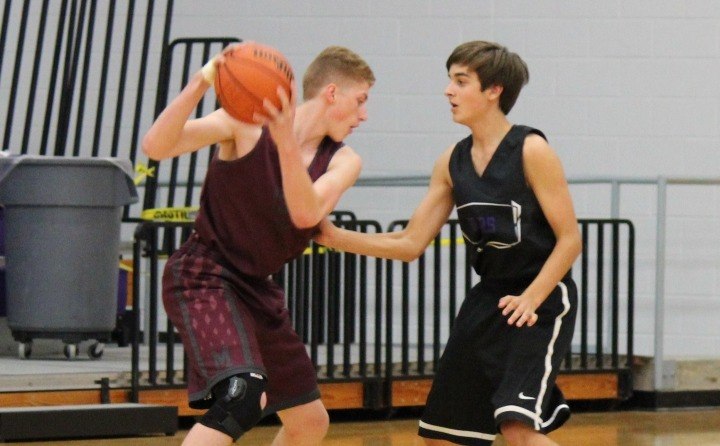
[Photo: player catching the ball in a game with defenders closing in]
Panic has two flavors
When the ball hits their hands in a real game, they panic, and it usually shows up one of two ways.
The first is the hot potato. They catch it and immediately need it gone, like it’s burning their palms, so they fling it somewhere without ever really looking. The second is the bull in a china shop. Head down, ball out front, charging forward into traffic with no plan for what happens when they get there. Both of these end in the same two places. A turnover, or a rushed shot they had no business taking.
And here’s what makes it frustrating for them and for me. They know what to do. Put them in a calm setting and they’ll make the right read every time. The knowledge is in there. The speed of the game just wipes it clean.
This isn’t a them problem, it’s a brain problem
There’s real science behind why this happens, and it’s a little brutal to hear.
Studies on basketball players making decisions under time pressure keep landing on the same finding. When players feel rushed, they make faster decisions at the direct cost of accuracy. Researchers call it the speed-accuracy trade-off, and it hammers inexperienced players hardest. Their decision-making holds up fine when there’s no pressure, then falls off a cliff the moment the clock and the crowd and the defender all show up at once. The exact situation where a good read matters most is the one where panic makes it least likely.
So when a young player looks lost in a game, it’s usually not that they forgot how to play. It’s that their brain, under pressure, grabbed the fastest option instead of the best one. Speed became the enemy of thinking.
The fix isn’t to think harder. It’s to buy yourself a little time so the thinking has room to happen.
Patient does not mean slow
This is where people get it twisted. When I tell a player to be more patient, they hear “play slow,” and that’s not it at all.
Watch the best guards in the NBA. Shai Gilgeous-Alexander gets swarmed every single night. Defenses build their whole game plan around stopping him, they blitz him, they wall off the paint. And he still gets exactly where he wants to go, because his game is built on pace changes. He slows down, lets the defense commit, then goes. He lets the game come to him instead of forcing it. That’s not slow. That’s controlled.
Patience is about letting things develop instead of pre-deciding your move before you even catch the ball. When I catch it and take a beat, look at everything I can do with that time:
I can let my teammate finish their cut instead of throwing to where they used to be. I can let the floor clear so I actually have room to drive. I can let a defender close out too hard and too fast, then blow right past him. I can let help defense slide toward me, which means someone is now open, and hit them. Every one of those is a good outcome that only exists if I gave it a second to appear.
The panicked player gets none of that. They caught it, they picked chaos, and the play was over before any of the good options had time to show up.
How we actually train it
You can’t just tell a kid “be patient” and expect it to hold up when the game speeds everything up. You have to build it in layers, in places that feel a little uncomfortable on purpose.
It starts in the warmup. Instead of mindless dribbling, I have them making decisions and dealing with contact before they ever scrimmage. Small reads, someone bumping them, choices to make. That way their brain is already in read-and-react mode instead of getting ambushed by it later.
Then in practice, the core habit. Catch, take a beat, survey the floor, then make a read. In that order. Catch first, look second, decide third. Most young players collapse all three into one panicked instant. We pull them apart on purpose and slow the sequence down until it’s automatic.
And I make them do it from spots that feel threatening. Catching at the top of the paint with bodies around them. Catching in the short corner where a defender can crowd them. If they only ever practice catching wide open in space, they’ll never be ready for the moment a game actually throws at them, which is catching with someone in their chest. I also give them a move or two to engage the defense, a jab, a shot fake, a rip through, so they have a tool to buy time instead of just freezing.
[Photo: player using a jab step or shot fake against a defender in a drill]
Mistakes are the entire point
Here’s the part nobody wants to hear. They have to mess this up, a lot, before it works.
In practice, a blown read is free. You throw it away, we talk about what you saw and what you missed, you catch it again and try something else. That’s the whole value of practice. It’s the one place where the cost of a mistake is basically zero, so it’s the place to make all of them. The kids who let themselves make mistakes and learn from them in practice are the ones who eventually stop making them in games. The kids who play scared and safe in practice never build the read at all.
So I want the bad reps. I want them catching in the ugly spots and misjudging the closeout and throwing it to a covered cutter, because every one of those teaches them to see it a half-second sooner next time. The panic fades through reps, not through pep talks.
Where the girls are now
They’re not fixed. This is a months-and-years thing, not a one-session thing. But the gap between practice and game is starting to close, and I can see the difference on film. There are catches now where instead of exploding into a turnover, they take the beat. They look. Sometimes they still make the wrong choice after that, and that’s fine, because at least there was a choice.
The goal was never to turn them into slow, hesitant players. It’s to get them to the point where the game feels like practice, where catching the ball with a defender in their face doesn’t shut their brain off. Where they can catch, stay calm, gather what they need, and still go get a bucket.
Two seconds. That’s usually all it takes to go from a panicked turnover to a real decision. Give yourself the two seconds.