
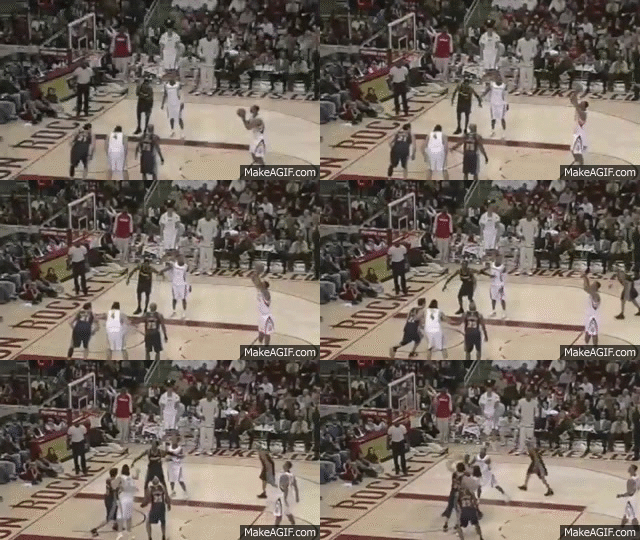
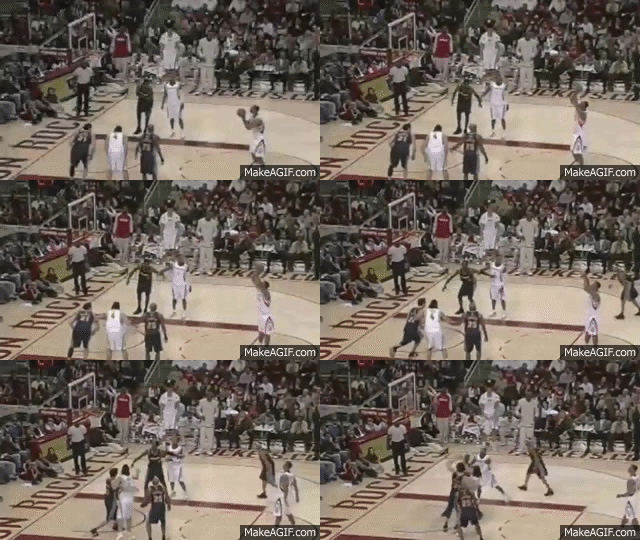
I had a high school girl who was one of the better shooters on her team. Tall, long, way bigger than most defenders she faced. For a while that covered everything. She could catch, take her time, pause at the top of her shot, and still get it off because nobody could reach it anyway.
Then she started playing up. Better defenders, longer athletes, actual length coming at her. Suddenly that pause mattered. Not because her mechanics were completely broken. Because she had a hitch built into her shot and had never had to pay for it until now.
She wasn’t unique. This is one of the most common shooting problems I see and one of the least talked about. The ball stops at the top. Just for a split second. But a split second in a jump shot is a long time.
[video: side angle of a shot with a visible hitch vs one that flows clean]
Why The Ball Stops
Two reasons. Both way more fixable than most people think.
The first is hand position. If your shooting hand isn’t behind the ball when you catch or pick it up, it has to travel to get there before you can release. So your body just waits at the top while the hand figures out where it’s going. That pause isn’t a mental thing or a bad habit you developed on purpose. Your hand is just trying to catch up.
The fix is almost annoyingly straightforward. Shooting hand between the ball and your body before anything else happens. Not off to the side, not cupped underneath like you’re carrying a tray of food. Behind it. When that’s right the hand is already loaded and there’s nothing to wait for.
The second reason is a growth spurt. Got bigger and stronger faster than your body knew what to do with the new power. So you slow down at the top to manage it, find the touch, then release. Completely understandable. Your body basically got an upgrade and didn’t come with a manual. The pause is your workaround.
Problem is, workarounds have a shelf life. Once the game speeds up and defenders get longer, that half second at the top is all they need.
You can see this at every level. Nic Claxton has a noticeable pause and it’s been a real problem, defenders time it, his free throw numbers show what it does to consistency under pressure. Kristaps Porzingis has a similar hitch but gets away with it more because he’s 7’3 and the contest window on him is just tiny. Doesn’t mean it’s helping him. It means he’s tall enough that it doesn’t always matter. Wemby is also seven feet and his shot flows clean. No dead spot, no waiting, one continuous motion. That’s the difference. Chuck Hayes had probably the most famous pause in NBA history. It was never good. It was just the only way he knew how to do it.
[photo: Wemby at his release point, or side by side with Claxton or Hayes]
Nobody Does This On Anything Else
Here’s the part that usually gets a laugh when I bring it up in a session.
Nobody pauses mid-throw on a baseball to dial in their accuracy. Nobody stops a golf swing at the top to find the right touch. You just learn to control the power through the motion itself. That’s how every other throwing or swinging movement works and a jump shot is no different.
Stopping at the top to find control is usually what’s destroying the control. Research on motor learning backs this up pretty clearly: smooth continuous movements are more consistent and easier to repeat under pressure than movements with built-in stops or hesitations. When you interrupt the chain, you’re not just slowing the shot down. You’re making it harder to replicate every single time, which is the opposite of what you’re trying to do.
This sophomore could feel his hitch knew it was there but couldn’t shake it. We slowed things down, worked on the mechanics in pieces. Didn’t really help. Then we just sent him into the shot with more speed. Body moving, momentum building, ball coming up as he rose. The pause had nowhere to live. Once the motion had momentum the hitch mostly disappeared on its own because there was no room for it anymore.
Three Players, Same Problem, Different Stages
The high school girl needed two things. Hand behind the ball, then more speed into the shot. Once both were there the motion connected into one thing instead of two separate things happening in sequence. She went from a catch and stand shooter to someone who could get her shot off on the move, off the dribble, in actual game situations. Not because we rebuilt everything from scratch. Because we fixed the one thing that was breaking the chain.
The high school boy just needed speed. That was it. The hand position was fine. The mechanics were fine. He just needed to stop giving the pause somewhere to exist.
Then there’s the middle schooler I’m working with right now who is still in the middle of figuring it out. His body is still changing and the hitch shows up and disappears depending on the day, which is pretty normal when you’re still getting used to your own limbs. The big shift for him was learning to be okay with feeling like he had less control. That was genuinely hard. The shot felt controlled when it stopped and out of control when it flowed, which is completely backwards. But he stuck with it. He watched his shot on film recently and couldn’t believe how quick his release looked. Six months ago he couldn’t get shots off at all. Now he’s getting them off in situations he never could before. He was shocked. Which is honestly one of my favorite things to watch happen.
The feeling of control and actual control are not the same thing. The shot that feels controlled because you paused is usually the shot that gets blocked.
[video: drill footage or player shooting with flow vs with a hitch]
How To Fix It
Step one is the hand. Shooting hand between the ball and your body before anything else. That’s your starting position every single time you touch the ball.
Step two is film yourself from the side. You will see the hitch even if you cannot feel it. This is almost guaranteed. Most players watch it back and go oh. That’s the moment you need before anything else makes sense.
Step three is the running shot. This is the drill that actually teaches your body what flow feels like.
Take a few steps into your shot off one leg like a layup, releasing it like a jump shot. Think half court heave rhythm, not arc. It’s going to feel like you’re just chucking it into the air. The shot might go everywhere. That’s fine. The point is that the momentum forces the ball to come out instead of sitting up there waiting. There’s no room for a pause when the body is already moving. That’s exactly the feeling you’re after.
Once you start feeling it, slow back down to a regular catch and shoot. You’ll notice how much more connected it feels compared to before. That’s the carry-over.
Don’t worry about makes during this. At all. A shot that doesn’t stop is the entire goal right now. Accuracy comes after the motion is working, not before. You can’t dial in the touch on something that’s broken in the middle.
Step four is just accepting that it’s going to feel wrong for a while. Flow feels like chaos when you’re not used to it. Give it real reps before deciding it isn’t working. Every player I’ve done this with has gone through the “this feels terrible” phase before the “wait this actually works” phase. The middle schooler above included.
[video: running shot drill then regular catch and shoot showing the carry-over]
A Shot That Flows Is A Shot That Holds Up
A catch and stand shooter who needs a wide open look and plenty of time is limited. Works at one level until the defense figures it out. A shooter whose shot flows from start to finish can create their own look, get it off on the move, and stay consistent when things get fast and messy.
That’s what fixing this actually gets you. Not just cleaner mechanics. A shot that works when the game stops cooperating.
The traffic jam is fixable. Check your hand, keep it moving, and film it so you can actually see what’s happening. You probably can’t feel it yet but you’ll see it immediately.
|
If this sounds like your shot or your kid’s shot, the best first step is an evaluation session. Fill out the intake form and we’ll take a look at what’s actually going on. Book an Eval Session |