
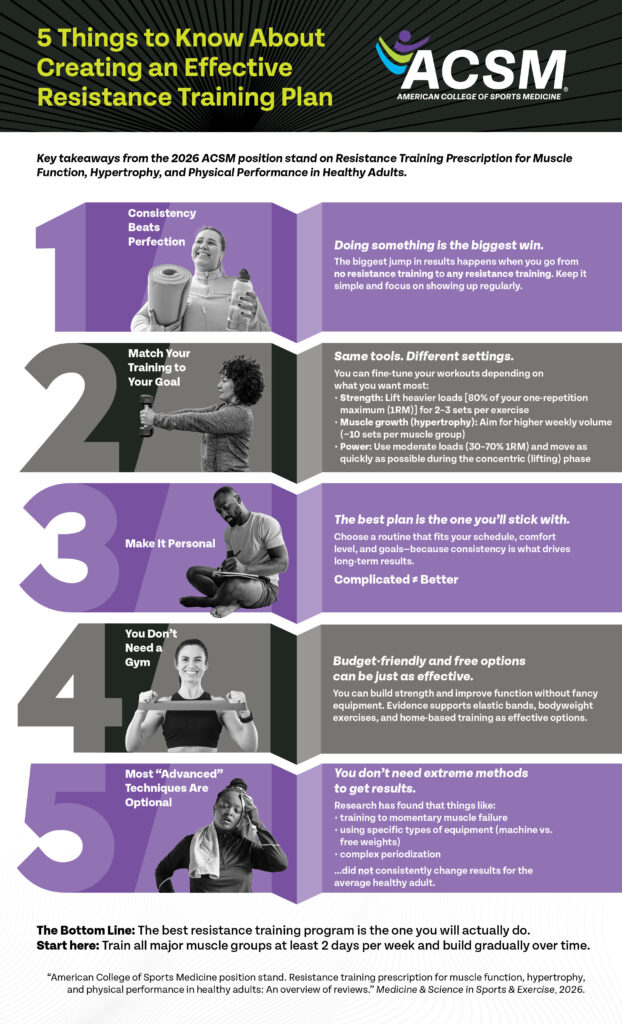
The American College of Sports Medicine published new resistance training guidelines in March 2026. First update in 17 years. They pulled from 137 systematic reviews covering over 30,000 participants, which is about as thorough as this kind of research gets.
The headlines focused on the heavy lifting stuff. Go hard, lift at least 80% of your max, train twice a week. That part makes sense, sounds very official, very science-y. But if that’s all you took away from it you missed the more interesting part.
[image: someone training with cables or dumbbells, not a shredded influencer, just a normal person actually working]
What the Guidelines Actually Say
The ACSM broke things down by goal. Strength, muscle growth, and power each have their own variables. For strength, heavier loads and lower volume. For muscle growth the emphasis shifts to total weekly volume, around 10 sets per muscle group per week, with the lowering part of each rep mattering more than most people realize.
Here’s the part that quietly ended a lot of gym arguments. Muscle growth was shown to happen across a huge range of loads, from about 30% of your max all the way up to 100%, as long as the effort was there and you were getting close to your limit within the set. The rep range mattered less than people thought. Effort mattered more.
And then there’s this. The most meaningful gains in the research came from simply moving from no resistance training to any form of resistance training. Not from finding the optimal split. Not from the perfect exercise. From showing up and doing something hard consistently.
The fitness industry has spent years making this feel incredibly complicated. Turns out it kind of isn’t.
Why “Just Go Heavier” Isn’t Always the Answer
When someone is new to training, or coming back after a long break, the early weeks are mostly about the nervous system figuring out what’s happening. Research has long shown that beginners can get significantly stronger through improved motor unit activation and coordination, even before any real muscle growth shows up. Their body is learning how to use the muscle it already has. Which honestly sounds more impressive than it is, but it’s real.
That matters because it means almost any rep range done with real effort is going to work at that stage. The body is not picky. It just needs the signal that something hard is happening and it should probably adapt.
The mistake people make is assuming that because heavy loads are optimal for strength on paper, that’s where everyone needs to start. That’s not what the research says. That’s not even what the guidelines say if you read past the headline. <div style=”border-left: 4px solid #FF6B35; padding: 10px 16px; margin: 20px 0; font-style: italic; color: inherit;”> The best program isn’t the most optimal one on paper. It’s the one that gets you in the door, pushes you hard enough to adapt, and keeps you coming back. Ideally without making you miserable. </div>
The Guy Who Hated Heavy
I have a client who’s been training with us for a while now. Older guy, one of the favorites in the group, the kind of person everyone is happy to see walk in. When we started incorporating heavier lower rep work he was absolutely miserable. He tried. He showed up. He pushed through it. But he hated every second of it, felt like things were flaring up, and started dreading sessions in a way that was pretty obvious.
So we changed it. Climbed the reps up. Fifteen per set, sometimes twenty, working hard all the way to the end. He looked at the weight I gave him the first time like I had personally insulted him and his entire family. Then he did the set and was cooked by rep fourteen.
That’s kind of the point.
He started pushing himself harder because the higher rep range gave him something to actually work into. He could feel the effort building across the set. He knew when he was close. And he started actually looking forward to coming in, which for some people is genuinely the hardest part of this whole thing.
Strength went up. Muscle went up. He’s still training.
Now here’s the science behind why that’s not just a consolation prize. Research shows that for muscle growth, training closer to failure produces more hypertrophy regardless of the rep range you’re working in. For strength, how close you push to failure matters less than consistent progressive challenge over time. So working hard at higher reps isn’t a workaround. It’s a legitimate path to the same adaptations, especially for someone who’s newer or coming back.
[image: someone grinding through a high rep set, clearly working hard, not a highlight reel]
When the Whole Playbook Needs to Change
Then there’s my client with shoulder arthritis. Different problem, same lesson.
Every time we tried loading her shoulder through a normal range of motion she paid for it. Not just during the session. The next day, sometimes the day after that. We went through modifications. Adjusted angles. Tried lighter loads. Tried machines. Tried being very optimistic about it. None of it was working the way it needed to.
Eventually we landed on isometrics. Meaning she holds a position hard with no movement happening at the joint. Just squeezing against resistance and staying there. Isometric exercise involves contracting a muscle while keeping the joint stable rather than moving it through a range of motion, which makes it particularly useful when loading a joint through movement is the problem. The Arthritis Foundation specifically recommends isometrics when joints are compromised because you get a real muscle contraction without the grinding.
It does not look impressive. Nobody is going to post it on Instagram. But research shows isometric holds can actually reduce pain signals, not just avoid making them worse. So we weren’t just finding something she could tolerate. We were finding something that was actively helping.
Her strength is going up. Her shoulder isn’t getting worse. She’s training hard in a way her body can handle. That’s the whole goal.
Is it optimal for someone without arthritis? No. But optimal for who is always the real question and it’s one the fitness industry is pretty bad at asking.
[image: someone doing an isometric hold, wall press or similar, calm and controlled]
The Variable Nobody Talks About
The ACSM’s updated position is built around sustainable long term engagement, with the finding that the best resistance training program is the one you’ll actually stick with. That’s a research body with 30,000 participants behind it telling you that showing up consistently is a variable. Not a soft motivational one. An actual measurable one that shows up in the data.
So if you’re grinding through something you hate, or avoiding training because nothing feels right, or quietly assuming whatever you’re doing isn’t good enough, that’s worth paying attention to. Not because you should just do whatever’s easy. But because finding the version you can actually push hard in and keep doing is not a compromise. It’s the strategy.
Seventeen years of new research and the takeaway is basically: work hard, keep going, find what you’ll actually do. Honestly kind of annoying how simple that is.