
You Found a Workout That Fits You. Then You Trained Alone and Quietly Quit.
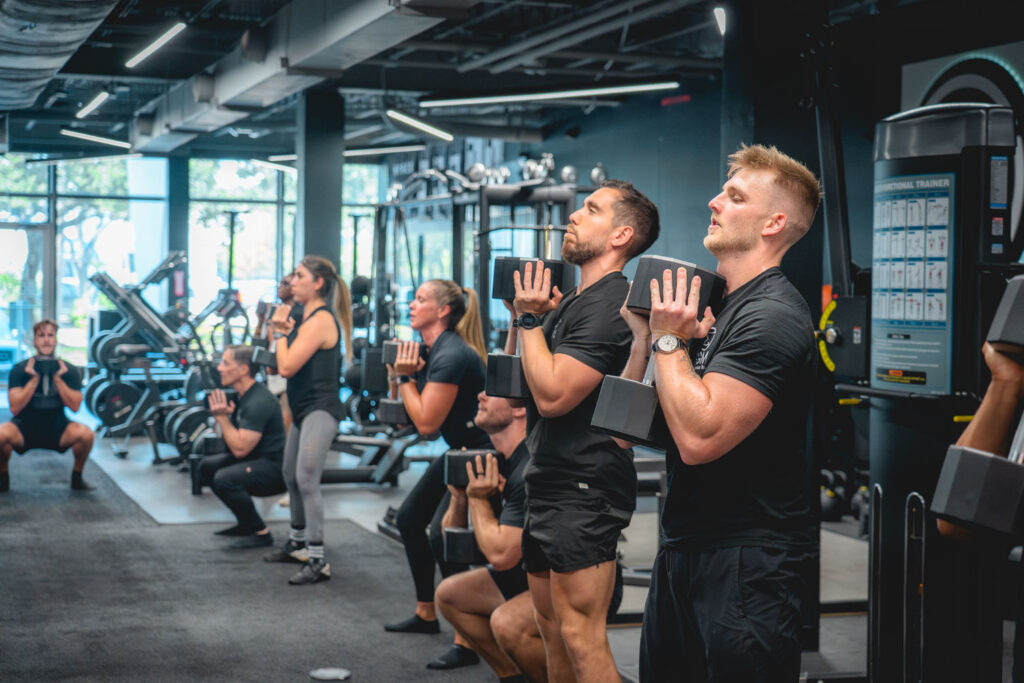
There was a client who came to me straight out of the CrossFit and cycling world, and she loved every second of it. The loud music, the leaderboard, a room full of people yelling encouragement at her while she voluntarily did something awful. She pushed as hard as anyone in there, and for a few years it was the best part of her week.
Then her hip started talking. Her back joined in a little later. Nothing dramatic, no single injury with a good story attached, just the slow grind of a body being asked to do the same high-intensity thing over and over with nobody paying attention to the details of how she specifically moved. In a room of thirty people and one instructor, nobody’s watching your hip.
What happened after that is the part I actually care about, because it’s the part that quietly wrecks people.
[Photo suggestion: crowded high-intensity group fitness class, people mid-workout]
She got scared. Not of exercise in general. Scared of anything that wasn’t built specifically for her body and supervised by someone who knew exactly what her hip was doing. The classes that used to be the highlight of her week turned into a threat. So she retreated all the way to the opposite corner, the safest and most individual training she could find, and privately decided she was probably done with big sweaty rooms full of people for good.
I see some version of this constantly. Someone comes from a great community setting, CrossFit, Orangetheory, a spin studio, a big yoga or Pilates room, and those places did something valuable for them. They built a habit. They gave them people. But the training itself stalled them out or banged them up, because a general program run for a crowd can only ever be so specific to one body. And then, because the group and the getting-hurt came bundled together, people throw out the group along with the program.
That’s the false choice at the center of all of this. You think you have to pick a lane. Community, which is fun and motivating and completely general and eventually aggravates something, or a program that fits your body, which works and is also lonely and extremely easy to skip the second life gets loud. Get supported or get trained correctly, choose one.
It’s fake. You can have both, and more to the point, you probably need both.
Community is a training variable, not a reward
Here’s what most people get backwards. They treat the social side of fitness as the soft, secondary part, the nice-to-have you enjoy once you’re finally fit enough to belong. The real work, in their mind, is the program.
The research points the other direction. When you look at who actually sticks with exercise over the long haul, the perfect program is not the thing that separates the people who last from the people who vanish by March. Social support does a lot of that work, and here’s the detail that matters most: support built specifically around your training predicts adherence better than just having generally supportive people in your life. Your spouse cheering you on from the couch is lovely. It’s not the same as someone who’s actually in it with you, who notices when you don’t show.
That reframes the whole thing. The people aren’t the reward. They’re a lever on the one variable that actually determines results, which is whether you keep doing this at all.
And that variable is basically everything. You can build someone a flawless program, fitted to their body and goals and every restriction they’ve got, and if they quit it in ten weeks because it was them alone with nobody to answer to, the flawless program produced nothing. All the other variables sit downstream of whether you actually keep going, which is a boring thing to be true but it’s true.
What keeps people consistent when it gets hard
Willpower is not the answer, even though it’s the one everybody reaches for. When work explodes, when you’re discouraged, when the results are slow and the couch is right there, discipline is the first thing to evaporate. It’s a terrible thing to build a decade of training on.
Being tied to other people is far more durable. When you know someone’s expecting you, when skipping means letting a person down and not just a calendar reminder, you show up on days you absolutely would have bailed solo. That’s not a character flaw. That’s just how humans are built, and the smart move is to use it instead of pretending you’re above it.
The pull of this runs deeper than motivation, too. Research on social connection and health has found that people with stronger social relationships have a 50% greater likelihood of survival than people with weaker ones, an effect the researchers put on par with quitting smoking and bigger than obesity and inactivity. Connection isn’t a lifestyle garnish. Your body treats it as load-bearing. Building your training around other people is good for you in its own right, not just a way to trick yourself into showing up.
[Photo suggestion: small group training session, a few people working out together, coach present]
Back to my CrossFit client, because her story doesn’t end in the safe corner. Once we’d worked together long enough for her to trust what her hip and back could handle, I showed her something she didn’t think existed. You can take those same group formats she loved and modify them to fit her. She could be in a room full of people feeding off that energy and still be doing the version that was right for her body, not the one-size-fits-everyone version that hurt her.
That was the middle ground she was sure didn’t exist. And once she had it, something loosened. Not all at once, and honestly she still texts me sometimes asking if a class is going to be too much. But she understood now that she could regulate her own dial. She didn’t have to redline just because the room was redlining. She’s back in cycling and some yoga she’d written off completely, picking her spots, mostly having a blast. Still cautious. That part didn’t fully go away and maybe it shouldn’t.
The guy who was sure he’d hold everyone back
Different client, opposite starting point. This one had basically never worked out before he came to me. We spent months building him up one-on-one, just the two of us, until he had real strength and real consistency for the first time in his life.
At some point I floated the idea of a small group. I thought it’d push him harder, and honestly he needed the people. He was retired, and the only faces he saw at the gym were college kids half his age. He wanted no part of it. He was certain he’d be the weak link slowing everyone down, and he didn’t want to inflict that on anybody.
I talked him into it anyway. He still swears, to this day, that he’s holding everyone back. I don’t think I’ve fully convinced him he isn’t. But it stopped mattering, because he looks forward to those groups now, and they get him in the gym more than he ever managed alone. Left to his own schedule he talks himself out of it. Tied to a group he shows up. Whatever you want to call that, it did something no program of mine ever did.
How to actually build this in
You don’t need to overhaul your life or join something new and terrifying. You just need to add threads of connection to the training you’re already doing. A few ways, depending on where you’re starting from.
If you train mostly on your own, find your one person. You don’t need a squad. Find a single regular you already cross paths with whose days overlap with yours, and actually connect. Say hi, land on similar workout days. Once there’s a person you’d feel weird bailing on, your attendance quietly changes, because now a skipped session costs you something real.
If you’re solo and stalled, look at small group. A small group built around people with similar goals gives you the specificity a big class can’t and the community a solo program can’t. That’s the actual middle ground, and for a lot of people it’s the whole answer.
If your strength work is already dialed, use the big communities for your gaps. This is where all those classes you might’ve written off become perfect. If your lifting is handled but your cardio is nonexistent, or your mobility is an afterthought, a big group class is a great place to cover exactly that. Let the community setting do what it’s great at, and stop asking it to be your everything.
So stop treating community as the fun extra you get after the real work. It’s closer to the thing that lets the real work survive a hard month. Find your version of it, fit it to your body, and lean on it on the days you can’t carry yourself. That’s most of the game, honestly.