Your Kid Looks Great in the Driveway. Then the Game Starts.
Imagine a driving school that ran like this. You show up, sit in a parked car in an empty lot, and for three straight months you practice turning the wheel and working the pedals. Nothing else. No traffic to read, nobody merging next to you, nobody making you decide when to brake. Just the raw movements, thousands of reps, in a silent lot. Then on the first day of month four, they toss you the keys and send you onto the highway at rush hour.
You’d call that a scam. Turning a wheel in an empty lot has almost nothing to do with the actual skill of driving, which is really the skill of reading a chaotic situation and deciding what to do inside it.
And yet this is almost exactly how most kids practice basketball. Alone in the driveway, running the same moves against nobody, all the time in the world. Then they walk into a game and we’re confused when it looks like they’ve never played before.
[Photo suggestion: kid practicing basketball alone in an empty driveway]
The kid who froze the second it counted
I had a middle schooler who was, no exaggeration, good in his driveway. Nice handle, a real step-back jumper, could drive either direction. If you watched him work out alone you’d have thought he was a legit player.
Put him in a game and something else happened. He’d catch the ball and just seize up. It reminded me of the Monstars in Space Jam the instant they lose the powers they stole, all that ability suddenly just gone. Everything he could do flawlessly by himself evaporated the moment a defender was close and he had to decide, in real time, which move to pull out and when.
Here’s the thing people get wrong about that. They see the freeze and assume the kid needs more skill work, more moves. He didn’t. He had the moves. What he’d never practiced, not once, was using them in the environment he was actually being asked to use them in. He’d trained the wheel-and-pedals part to perfection and never once driven in traffic.
Skills don’t come with a built-in “when”
This is the part isolated practice quietly leaves out. Doing a crossover a thousand times teaches your body how to do a crossover. It doesn’t teach you when to use it, how a defender’s stance changes it, or how to decide in the half-second a game gives you. Those are separate skills, and a game is made almost entirely of them. So a kid can have a beautiful bag and still look lost, because the bag was never the hard part. The reading and deciding is, and you only build that by practicing in situations that force you to read and decide.
The research says the messy version wins
This isn’t just my gym theory. Motor learning researchers have studied exactly this. When you practice skills jumbled together and reactive instead of grooving one thing at a time, you perform worse in the session itself. More misses, messier. But it transfers to real performance dramatically better than clean, blocked, one-skill-at-a-time practice.
There’s a study on baseball hitters that makes the point better than I can. They gave experienced players six weeks of extra batting practice. One group hit fifteen fastballs, then fifteen curveballs, then fifteen changeups, all organized. The other saw the same pitches, same number of swings, but in random order. In practice the random group looked worse. Tested afterward, they’d improved nearly twice as much. Same reps. The only difference was whether practice made them read and react or just repeat.
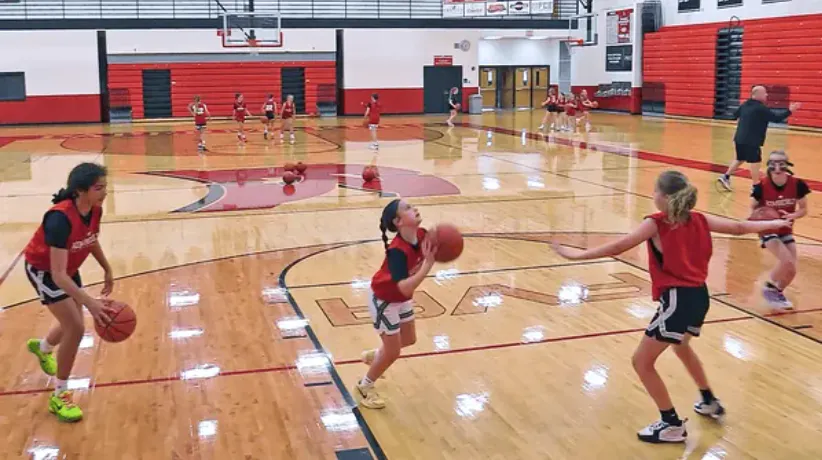
Back to my middle schooler. We changed one thing. Everything became reactive, me nearby, defending, making him decide on the fly which move fit. Our sessions got uglier. He missed way more than he did alone, and early on it bugged him. But the misses were the point, because he was finally practicing the thing that broke in games. It took a bit. Then one game he caught it, read it, and just went, and for the first time he looked like a kid who’d played basketball before. Not instant. But the reverting stopped.
The high schooler who kept snapping back to old habits
Different kid, same trap in a new form. A high schooler whose shot we were rebuilding. He had deep old habits baked in, both hands on the ball and a slow release with a little pause up at his head, and we were reconstructing the whole thing.
I started the way you’re taught to start, very isolated. Clean form shooting, close range, groove the mechanics with zero pressure. And in our sessions it looked like it was working, his form cleaning up nicely when it was just him and the rim.
Then he’d play a game and revert instantly. Two hands, slow release, the pause right back at his head. Everything we’d built in the quiet reps dissolved the second the game got fast and someone flew at him. The new shot existed, but only under lab conditions.
My instinct was patience. Keep grooving the clean version, wait for it to get automatic enough to survive a game. But watching him snap back week after week, I moved way earlier than I normally would. I started mixing in game-like moments, contested reps, shots on the move, a clock, someone coming at him, well before his isolated form was what I’d call finished.
That’s when it started sticking. Once he had to hold the new mechanics together while reacting to something, the shot stopped being a driveway trick and became his real one. If I’d waited for the isolated version to be perfect first, he might still be reverting.
[Photo suggestion: high school player shooting a contested jump shot in a game]
What’s really breaking is confidence
It’s worth naming what actually happens in that freeze, because it isn’t purely mechanical. When a kid seizes up in a game, it’s usually not that his hands forgot the crossover. It’s that the moment is unfamiliar and he doesn’t trust what he’s about to do, so he hesitates, and hesitation in a game may as well be a stop sign.
Confidence doesn’t come from being told you’re good, and it doesn’t come from a reel of makes in an empty gym. It comes from having already been in the uncomfortable spot, gotten it wrong, and figured out you survive it. That’s the quiet reason reactive practice works. Every messy contested rep where a kid loses the ball or bricks the shot teaches him that a defender in his face isn’t the end of the world. By the time the game comes, it’s familiar. He’s been here. The misses in practice are where the confidence gets built, which is why practice that never lets a kid fail never really prepares him to believe in anything.
Even the best in the world train the chaos
If you think this is only for kids figuring it out, look at Steph Curry. Maybe the best shooter who’s ever lived, a guy who could drain clean catch-and-shoot threes all day, and his development staff still puts him through drills built on chaos. In one, a coach bounces the ball to a random spot and Curry has to chase it down and score right away while two coaches defend him and try to make it a mess. As one of his coaches put it, they try to put him through the stuff he’ll actually face in a game, off the move, off-balance, contested, instead of straight clean shots. The best shooter alive spends real time making hard, ugly, reactive shots on purpose, because that’s what games are made of.
How to scale it to any level
Here’s where people get nervous, so let me be clear. This does not mean you throw a brand-new kid into total chaos. Too much too soon and a beginner just drowns, and the research backs that up too. You match the amount of chaos to the player.
For a brand-new kid the “situation” can be tiny. Make them alternate instead of repeat. Go left, then right, then left. Shoot, then drive, then shoot. Even that small bit of having to choose rather than run a script is a huge step up from twenty identical reps, and it’s plenty for someone just starting out.
As they get comfortable, crank it up. Tighter space so they handle the ball in traffic. A shot clock so they can’t wait until they feel ready. A passive defender, then an active one, then full live reads. You’re walking them from the parking lot to the highway on-ramp by on-ramp, instead of parking them for months and flooring it into traffic.
None of this needs fancy equipment. A phone timer is a shot clock, a chair is a defender to read instead of a cone to blow past. What matters is that every rep asks a question instead of just repeating an answer.
If your kid can only do the skill perfectly alone and in silence, it isn’t finished yet. It’s the wheel-and-pedals part. The game is doing it while the world comes at you, and the only way to get good at that is to let a little of the world come at you first. Start small. Just stop practicing like the parking lot is the whole test.