
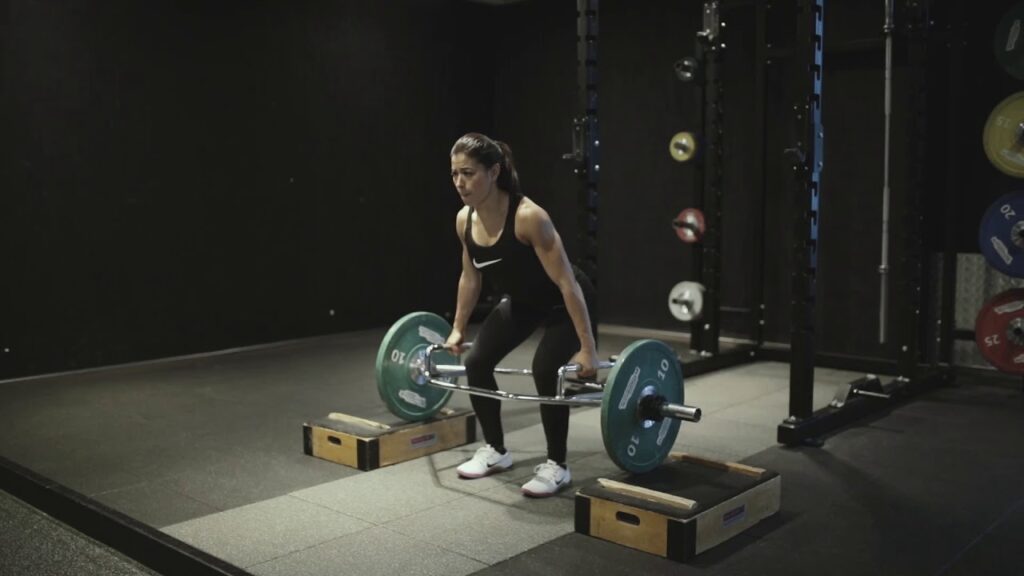
I have a client who used to get a tailbone flare-up every single time we deadlifted to the floor.
Not soreness. Not a tweak she’d shake off by the parking lot. A real one. The kind that makes you sit a little sideways for about a week and reconsider your relationship with chairs.
For a while she figured that was just the cost of deadlifting. Like the flare-up was printed on the receipt and she’d already agreed to the terms. Deadlifts hurt your back. Everybody knows that. That’s the deal.
That is not the deal.
[image: deadlift setup from the side, mid-hinge]
The myth doing the damage
Here’s the belief underneath almost every “I can’t do that exercise” conversation I have. People think certain movements are mandatory, and that their body is either built for them or broken.
Both halves of that are wrong, and the second half is the one that actually does harm. Because once you decide your body “can’t deadlift” or your shoulders “can’t press,” you’ve turned a temporary mismatch into a permanent identity. You’re not a person who needs a different setup right now. You’re a person with a bad back. Forever. It’s practically on your business card.
An exercise is a tool. That’s all it is. Nobody stands in their kitchen feeling inadequate because they couldn’t open a jar with a hammer. They get the right tool and move on with their day. But put a barbell in front of someone and suddenly it’s a referendum on their entire worth as a physical being.
It isn’t. If a movement is hurting you or skipping the muscle you’re trying to train, it’s the wrong tool for you today. Not a verdict. Just today.
So when does an exercise actually not fit? Three reasons. And you probably already know which one is yours.
Reason one: it hurts in a way that doesn’t settle
Back to my deadlift client.
The problem was never her back being weak or “bad.” The problem was that she doesn’t have the hip internal rotation yet to fold all the way down to the floor. So as the bar got low and her hips ran out of room, her lower spine quietly took over a job it never should have been doing. The weight has to go somewhere. It went to the one structure least equipped to handle it, and then billed her for a week.
The fix was not “push through it.” The fix was also not “deadlifts are bad, never again.” Both of those are lazy.
What we actually did: we limited the range. We stopped going to the floor and worked in the range where her hips could still do their job, and we changed her stance to give those hips a better angle to work from. Then, separately, we started opening up the back of her hips with pigeon stretch to build the internal rotation she was missing. As that range improves, we lower the movement closer and closer to the floor. She earns the depth instead of forcing it.
[image: pigeon stretch]
Now, here’s the part people get stuck on. They hear “limit the range” and assume that means watered-down, half-effort, participation-trophy lifting. They think they’re settling.
They’re not, and this is where the research is genuinely reassuring. When you actually measure it, full-range and partial-range training come out similarly effective for building strength. Unbiased measurements of muscle strength tend to find that full-range and partial-range training are similarly effective for strength development. She is not getting a lesser workout. She’s getting a workout her hips can actually pay for, while we build the thing that’ll let her go deeper later.
Limiting the range isn’t quitting. It’s just refusing to borrow strength from a body part that didn’t agree to the loan.
Reason two: the wrong muscle keeps stealing the rep
I had another client rehabbing both wrists. Couldn’t load them at all for a while. Which is a problem, because a huge amount of core training runs straight through your arms. Planks, anything in a push-up position, anything where you’re bracing through your hands. Her wrists would tap out long before her core got anywhere near challenged.
So we had a choice. We could keep throwing her at exercises where the weak link failed first and call it “core training,” even though her core was basically a bystander. Or we could find the actual target and hit it directly.
We went with movements that challenge the core without asking the arms to do anything. Deadbugs. Hollow holds. Things where the core is the star and the wrists get to sit out. Her core got trained hard. Her wrists got to keep healing. Nobody had to be a hero.
[video: deadbug and hollow hold demo]
This is the trap with a lot of “I’m doing the exercise but not feeling it” situations. You’re not weak in the muscle you think you’re training. You’re weak somewhere upstream, and that weak link quits before the real target ever gets a turn. Forcing the movement just trains your body to get better at compensating, which is the opposite of what you wanted.
And to be clear, the plan is to get her back to loaded, arm-driven core work eventually. That arm-to-core connection is genuinely useful and worth having. We’re just not going to chase it while the wrists are still the thing that breaks first. We’ll add it back when she can actually express it instead of just survive it.
Reason three: it has nothing to do with what you want
This one’s my favorite, because it’s the one nobody wants to hear.
I have a client who wanted to train pull-ups. Why? Because they look cool. That’s it. That was the whole reason, and honestly, fair. They do look cool. Pull-ups are an objectively impressive thing to be able to do.
But every time she got consistent with them, her shoulder revolted. And when we actually talked through what she wanted out of training, it was this: be in the best shape she can, build visible muscle, feel strong, see the effort pay off. Pull-ups were nowhere on that list. They were a separate, cosmetic side quest that happened to come with a shoulder tax.
Here’s the thing the fitness internet won’t tell you: there is no single exercise you have to do. Not one. You can build the same muscle a dozen different ways. Different exercises can produce growth in different regions of a muscle, but that’s largely an issue of exercise selection itself, since specific exercises can drive gains across multiple regions of a muscle. Translation: your lats and biceps don’t know whether they’re being trained by a pull-up or something else. They just know they’re working.
So we had two options. Option one, if pull-ups really mattered to her, we’d improve her shoulder flexion and build the capacity to handle them. Totally doable. But they didn’t matter to her. So, option two: we trained the exact same muscles with a setup her shoulder was happy with. Pulldowns, positioned further out from the cable so the angle kept her shoulder in a range it could handle, with support the pull-up never gave her.
And here’s my favorite footnote to the whole thing. Earlier, before the shoulder stuff, she’d actually built up to six solid pull-ups. Then she took a break from them entirely. When she came back and tried, the strength was still there. She hadn’t lost it by stepping away.
That’s the whole point in one story. The pull-up was never the source of the strength. It was just one expression of it. Drop the movement, keep training the muscles, and the ability doesn’t evaporate. It was never living in the exercise. It was living in her.
So what do you actually do
Pick the one exercise that’s been bugging you. The one that hurts, the one you can never “feel,” or the one you keep grinding away at for reasons you’ve never actually examined.
Then ask one question: is this movement actually relevant to what I’m training for?
If yes, you don’t quit. You figure out the one thing standing in the way. Maybe it’s range. Maybe it’s a stance. Maybe it’s a weak link upstream that needs to catch up first. You build that, and you earn the movement instead of forcing it.
If no, you let it go without ceremony and train those same muscles a way that works for your body right now. No guilt. It was a tool. You picked a better one.
None of this is permanent. The deadlift client will get to the floor. The wrist client will get back to loaded core work. The pull-up client could have pull-ups tomorrow if she ever decided she wanted them. “Not right now” and “not ever” are different sentences, and most people read the first one and panic like it’s the second.
Your body isn’t broken because a specific exercise doesn’t suit it today. It’s just giving you information. The hammer isn’t working on the jar. Go get the right tool.
Work With Me