
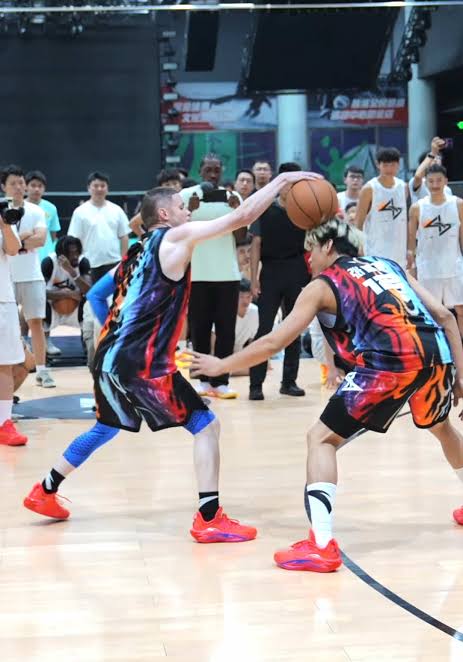
I had two of my players going at it in pickup the other day, and it was not a fair fight on paper. One of them’s a big, getting ready for high school, already carrying that size. The other one hasn’t hit his growth spurt yet, so he was giving up a lot of height and strength, and early on the game looked exactly like you’d guess. The big kid backed him down, went through him, got whatever he wanted at the rim. The smaller kid couldn’t get a clean look. There was some complaining. There’s always some complaining.
But I wasn’t paying attention to who was winning. I was watching what each of them was being forced to figure out.
[video: two mismatched players going at it 1v1, smaller player using speed vs bigger player using strength]
Because here’s what was actually happening under the frustration. The smaller kid, once he accepted that running straight into a bigger body was a dead end, started changing speeds and attacking angles. He had to. It was the only thing available to him. And the big kid, who was used to just being bigger, ran into a version of the same wall on defense, where his size alone wasn’t ending every possession, so he started leaning on footwork and touch he’d never really needed before. By the end of it they were trading baskets. The game had evened out. Nobody grew overnight. They’d just solved each other.
That’s the entire case for 1v1 against a mismatch, in one pickup run.
Why the mismatch is the whole point
Here’s the thing most people miss about 1v1. Playing someone your own size, your own speed, your own everything, doesn’t teach you much. You just do your normal stuff and so do they, and whoever’s a little better that day wins. There’s no problem to solve.
A mismatch is different. A mismatch hands you a problem your usual game can’t answer, and then makes you sit there in it until you find something new. The smaller player can’t out-muscle, so he’s forced to learn angles, pace, and finishing craft. The bigger player can’t rely on size against a quicker opponent, so he’s forced to develop feel and footwork. Neither one of those things gets built when the game is comfortable. Discomfort is the curriculum.
There’s real science behind this, and it’s not complicated. Skill develops best when you’re put in game-like situations that force you to read what’s in front of you and come up with your own solution, instead of running a memorized move on repeat. Coaches call it a constraints-led approach, and one of its core ideas is deliberately changing who you play against, different sizes, different styles, so you’re constantly adapting instead of grooving one comfortable pattern. In other words, the thing that felt unfair on the court the other day is exactly what the research says builds real, transferable skill.
The brothers, and the rules that fixed it
Let me give you the clearest example I’ve got.
I coach a pair of brothers, a sophomore and a middle schooler. Great for 1v1 in theory, brutal in practice, because the sophomore just won every single time. The younger one kept saying it was too hard, which, fair, it was. And the older one was getting bored winning, which meant he wasn’t working on anything either. So the game was useless for both of them, for opposite reasons.
So I changed the rules. That’s it. That’s the whole fix.
[image: two players starting a constrained 1v1, one with back to defender on the block]
The older brother, we happened to be working on his pullback dribble, so I made it so he could only score off a pullback. Suddenly he couldn’t just bully his way in. He had to set up and hit the specific move we were building, which meant the younger kid actually had a chance, and the older kid was drilling the exact skill he needed. Then for the younger brother, I started him with the ball already on his brother’s back, with the older one facing the hoop, so the younger kid began every possession with a real advantage and got to attack instead of just absorbing punishment.
One set of constraints, and the same lopsided beatdown became a rep machine for both of them. The younger one stopped complaining because he could compete. The older one stopped coasting because he had a real limit to work around. That’s what constraints do. They’re not about making it fair for its own sake. They’re about aiming the game at what each player actually needs to get better at.
The constraints I actually use
You don’t need anything fancy for this. A few simple rules change everything about what a 1v1 rep teaches:
A shot clock. Give the offense five seconds to score. This kills the endless dribbling and forces quick reads and decisions, which is what actually happens in a game.
A dribble limit. Two dribbles, sometimes one. Now the player can’t rely on just wiggling around forever. They have to be efficient and think about where they’re going before they go.
Scenario starts. Instead of always starting up top, begin the rep on the block, off a dribble handoff, facing up, coming off a cut. Each starting point is a different problem to solve, and games are full of different starting points, not just iso from the top of the key.
You mix and match these based on what the player needs and who they’re going against. That’s the craft of it. The constraint should point the player at the skill you’re trying to build, and the mismatch should make them earn it.
This isn’t just a kids’ thing
1v1 has taken some heat lately, and some of it’s earned. It blew up online as a content format, and yeah, basketball is a five-on-five game, so a player who only ever trains in isolation is missing a huge part of the picture. That’s a real critique. But it goes too far when people decide 1v1 is worthless. Done right, with mismatches and constraints, it builds reading, creativity, and craft that carry straight into real games. It should be part of any player’s development, not the whole thing, but a real part.
And if you want proof that learning to beat mismatches pays off, look at how the best players actually came up. Take LaMelo Ball. His older brother Lonzo has straight up said he was almost always too big to play LaMelo 1v1 growing up, so instead they ran 2-on-2 and 3-on-3 in the backyard in Chino Hills basically every day, LaMelo always the smallest one out there. And Lonzo credits exactly that for the player LaMelo became, that having to play up against bigger, older competition his whole childhood is why LaMelo isn’t scared of anybody on an NBA floor now. He didn’t develop that fearlessness playing kids his own size. He built it losing to his big brothers in the driveway.
Caitlin Clark is the same story. She grew up as the middle kid battling her brothers at everything, played in boys’ rec leagues as a little kid because there wasn’t a girls’ league for her age, and by eighth grade she was already playing against high school seniors. She’s said the thing she admired about her older brother wasn’t talent, it was that he outworked everybody, and that’s what drove her. She always wanted to play against people better than her. The best scorer women’s basketball has maybe ever seen came up doing exactly what I’m telling your kid to do.
That’s the pattern. The players who grow up solving problems bigger than them are the ones who come out the other side with real skill. Nobody hands it to you. You build it getting beaten and figuring out why.
So what do you actually do
Find someone who doesn’t match up with you. If you’re small and quick, go play the big strong kid. If you’re big, go find the fast little guard who’s going to make you move your feet. Then add a rule that points the game at whatever you’re trying to improve, and play.
You’re going to lose some. Especially at first. That’s not the game going badly. That’s the game working. The kid who only ever plays people he can already beat walks away feeling great and learning nothing. The one who keeps stepping into fights he might lose is the one who actually gets better.
Stop looking for the fair matchup. Go find the one that beats you, and figure out why.