
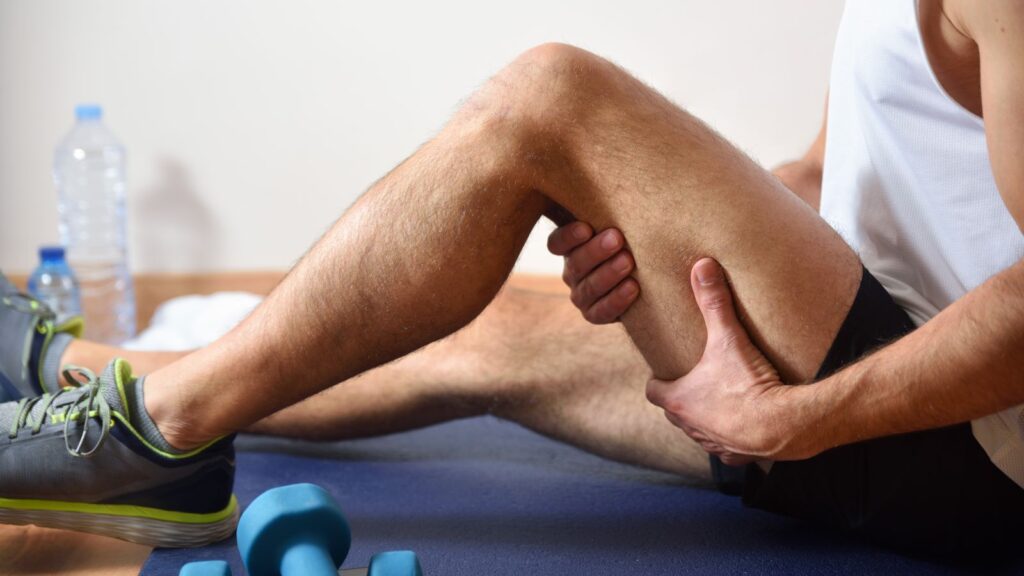
A client of mine spent a weekend playing baseball with his nephews, which is how most of these start. Nothing happened. No dramatic moment, no diving catch, nobody carried off the field. He just ran around like a man who had temporarily forgotten what age he was, and by Monday something in his quad had opinions about it.
Then he squatted, felt a sharp pain, and immediately decided he had ruined himself.
It was gone in two weeks.
I’ve got another client who had almost the exact same thing happen in her mid back, and hers took over three months. Nothing was torn in either case. Neither one ever saw a doctor. Same category of injury, same general severity, and the difference between two weeks and three months had nothing to do with luck or age or how fast anybody heals.
It came down to one thing, and it’s the thing almost everybody gets wrong.
Strains are boring, and boring is the good news
Let me take the scary part off the table before we go any further, because half of what makes a strain miserable is what you’re imagining about it.
Research shows a mild strain takes one to three weeks to heal, and a moderate one takes four to eight. That’s it. Most strains never need a doctor, never need imaging, and never leave a mark on you. Muscle tissue is good at this. It has been doing it for a very long time and it does not require your input.
What it does require is that you stop provoking it. The timeline I just gave you assumes the muscle gets left alone, and every time you feed it the exact movement that irritates it, you’re not toughing anything out. You’re pressing reset on a countdown that was ticking along fine without you.
[Image placeholder: client mid-set on a modified row]
How to tell it’s actually a strain
You can sort this out in about ten seconds, and you don’t need a scan for it.
Strains live in the muscle. Not on top of a joint, but in the meat of the thing, in a spot you could point to with one finger. If your pain is sitting right on a joint, that’s a different conversation and it’s worth getting looked at.
Strains are also activated by movement and only by movement. Sitting still, you’re fine. Sleeping, you’re fine. Then you do the one thing that provokes it and there it is, right on schedule, same exact spot, like it was waiting for you to come back.
Joint stuff doesn’t behave that way at all. Joint stuff aches when you’re doing nothing, it’s stiff in the morning, it hangs around whether you’re using it or not, and it’ll often come with swelling or a grinding feeling.
So: is it in the muscle or on the joint? Does it bother you when you’re sitting on the couch? Does one specific movement light it up every single time, reliably, like a switch? If it’s muscle, movement-only, and repeatable, you’ve almost certainly got a strain on your hands, and that’s genuinely the best news available in the world of things that hurt.
[Image placeholder: locating the pain, muscle belly versus joint]
The quad guy, and what he would have done without me
He wanted to squat. Immediately, and then continuously.
His pitch, delivered every session for two weeks, was that using the leg would help it heal faster. He said this with the confidence of a man who had done research, and the research he had done was that he wanted to squat.
So we skipped that side. Not leg day, not the workout, just that side. He trained the other leg, trained his whole upper body, kept his conditioning, and the only thing he surrendered was the single movement that reliably made his quad angry. He gave it up completely. Not lighter, not partial reps, not “let me just test it real quick.” Gone, for two weeks.
Then it was fine, and it stayed fine.
Now here’s the part that matters, and it’s the reason he needed somebody in the room. Pain fades before tissue is done rebuilding. That’s not a small detail, it’s the whole trap. Around day five he felt totally normal, and if he’d been on his own he would have loaded that leg up that afternoon, felt great for a set and a half, and put himself right back at day one. Then he’d have done it again. That’s how a two-week problem becomes a two-month problem, and it doesn’t happen because someone is stupid. It happens because their body lied to them and nobody was there to say wait.
He didn’t miss a single session, by the way. He just trained around it.
The mid back, and the rake
She’d never really strength trained before. Hydro classes, Pilates, a whole lot of PT over the years, but this was new territory for her. She felt something in her mid back during rows, and then it just stayed.
It took a while to even get her to call it what it was. She wanted it to be something else, or nothing, or a technique problem she could fix on the spot. Eventually she admitted it was a strain, which sounds like a small thing but it isn’t, because you cannot manage an injury you refuse to name. Once we called it, we could work around it. Rows changed. Range changed. She kept lifting.
And then it took over three months anyway.
Every couple of weeks she’d go out and do yard work. Rake, haul, drag bags of mulch around, whatever a Saturday demanded of her. She’d wake up Sunday and be right back at the beginning, and neither of us would know until she mentioned it offhand at her next session.
She wasn’t unlucky. She wasn’t a slow healer. She was pressing reset with a rake, over and over, for a season.
That’s what separates her from the quad guy. Not severity. Not age. Just the number of times the clock got restarted, which was zero for him and roughly six for her.
[Image placeholder: one-sided training, working around an injured side]
The one who thought she’d broken sleeping
Third client, and this is the one that keeps me honest.
She woke up with a weird feeling in her shoulder and neck. Slept funny, she figured, and it only bothered her when she raised her arm out to the side. So we treated it like it was nothing, worked around it, and I told her it’d be gone in a day or two.
It was not gone in a day or two.
A week and a half later she was genuinely rattled. She’d decided she had permanently lost the ability to sleep, that this was simply her life now, and that she needed to get in with a PT as soon as possible. And look, I understand it. When a thing doesn’t go away and you don’t know what it is, your brain will happily build you the worst version of the story.
But she didn’t need a PT. She needed us to stop being casual about it. We’d been avoiding the obvious movement while she was still catching that range incidentally, in other exercises, in ways neither of us had accounted for. So I cut the range down hard, modified more aggressively, and made sure those muscles were getting nothing at all.
A week and a half after that, neither of us could remember which shoulder it had been.
She saved herself six weeks of appointments and a stack of copays for something that a range adjustment fixed. That’s not me being smarter than a PT. It’s just that somebody had to look at it and say this is a strain, it’s behaving exactly like a strain, and it wants one thing from you.
What modifying actually looks like
People get this wrong in both directions. They either push straight through and keep resetting the clock, or they shut everything down and lose two months of training over a sore muscle.
Neither is right, and total shutdown has its own costs. The research on prolonged immobilization is not kind. You get more scar tissue, you lose strength you didn’t have to lose, and you come back weaker than the injury ever made you. Protect the injured tissue and let everything else keep working.
So here’s the order I go in:
Cut the range. The strain usually lives in one part of the movement, not the whole thing. Shorten it and you keep the exercise.
Change the angle. If one row angle hurts and another doesn’t, that’s not a compromise, that’s a solution.
Skip the side. One-sided problem, one-sided answer. Train the other leg. The other arm. Let the injured side sit.
Then train everything else hard. A strain in one muscle is not a reason to stop training your entire body, and this is the part people abandon first.
The rule underneath all of it is simple enough. If you can find a version of the movement that doesn’t touch the strain at all, do that one. If you can’t find one, don’t do the movement. And whatever you do, don’t split the difference by going “a little lighter just to see.” Seeing is how the clock resets.
What to actually do
Run the check. Muscle or joint, bothered at rest or not, one movement or many.
If it’s a strain, it’s boring, it’s going to heal, and your job is to stop handing it the thing it eats. Give it a couple of weeks clean. Not mostly clean, not clean except for one Saturday in the yard, because one Saturday is all it takes to start the whole thing over.
All three of these people got completely better. All three of them kept training the entire time. Not one of them needed a doctor, an MRI, or a single appointment with anybody.
What they needed was somebody to tell them what it actually was, keep them from poking it, and then keep them lifting while their body did what it was already going to do.