
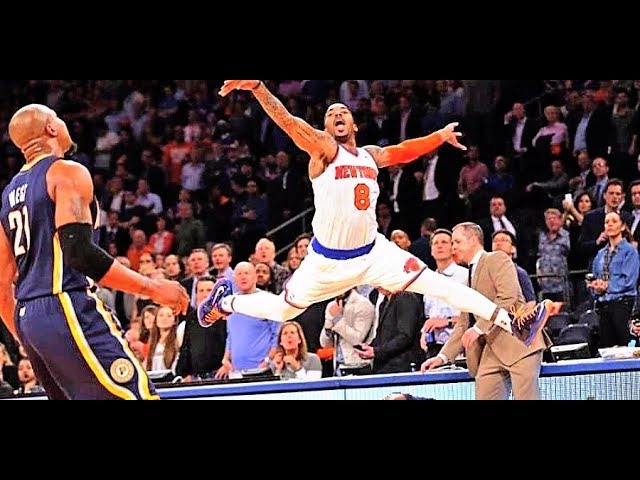
A high school kid came in looking like he was getting stabbed every time he shot the ball.
Not exaggerating. Every rep was a full-body emergency. Shoulders up, jaw clenched, eyes wide. The ball would come out and he’d wince before it even hit the rim, like he was bracing for bad news. Which, to be fair, it usually was bad news.
The problem wasn’t his mechanics. It was that his body was so tense his mechanics couldn’t actually work. You can have the right technique and still look like you’re defusing a bomb if you won’t relax long enough to use it.
Tension Is the Enemy of Everything You’re Trying to Do
Change of pace? Requires relaxation. Soft touch on a floater? Relaxation. Fast first step? Relaxation. Deceptive handle? You need to be loose enough that defenders can’t read you.
A stiff player is the most predictable player on the floor. Their body is already announcing what they’re about to do before they do it. There’s no hesitation move when you’re bracing. There’s no change of speed when you’re locked up. There’s no soft finish when your whole arm is tense on the way to the rim.
Research on athletic movement describes excess muscle tension as driving with the parking brake on. You’re generating force but fighting yourself at the same time, burning through energy and slowing everything down. The athletes who look effortless aren’t trying less. They’ve learned to stop working against themselves.
Watch the best sprinters in the world at full speed. Their faces are jiggling. Jaw loose, hands open, everything that doesn’t need to be working isn’t working. That’s not because the race doesn’t matter. It’s because they figured out that tension in the wrong places is just drag, and drag makes you slower.
Basketball is no different.
[Photo: Jamal Crawford dribbling, loose and flowing handle]
The Players Who Make It Look Easy
The players who look effortless aren’t less intense. They’re less tense. Those are different things.
Jamal Crawford said it as clearly as anyone ever has: “I think I’m at my best whenever I’m just not thinking. I’m just relaxed. I’m just playing, just hooping. It’s just basketball.”
Crawford played 20 years in the NBA and his entire game was built on being so loose that defenders had no idea what was coming. His handle wasn’t tight and low and protected. It was more out there, less structured, built on instinct and feel. His herky-jerky movements left defenders panicking. None of that works if he’s stiff. The whole game falls apart.
Then look at the other end of the spectrum. You’ve seen it. A big guy who can do everything inside but the second the ball comes to him on the perimeter he turns into a completely different person. Shoulders up, dribble pounding into the floor like he’s trying to punish it, eyes down, zero threat to do anything except get the ball out of his hands as fast as possible. That’s not a skill problem. That’s a tension problem. His body is telling you and the defender exactly what’s about to happen.
The difference between those two players isn’t just talent. It’s what their bodies are doing when they have the ball.
The High Schooler Who Looked Like He Was Getting Stabbed
Back to my guy. Every shot was a crisis. We tried working on his mechanics and nothing stuck because the tension was overriding everything we were building.
So we changed the rule. If he tensed up, the shot didn’t count. Didn’t matter if it went in. Didn’t count. We needed to break the habit before we could build anything on top of it.
At first he hated it. He kept wanting to focus on making shots, on getting the mechanics right, on fixing the thing that was visibly broken. But the thing that was visibly broken was a symptom. The tension was the actual problem.
Once we started getting him to play loose, miss loose, fail loose, everything changed. He started letting himself airball without the wince. He stopped bracing before the ball left his hand. And once the tension came out of his shot we could actually start teaching him things. When to add power. When to soften it. How to feel the difference between a shot that needs more and one that needs less. None of that is teachable when someone is just trying to survive the rep.
The Middle Schooler Who Dribbled Like She Was Being Chased
This one is a different version of the same problem.
I had a middle school girl who the second she caught the ball immediately started pounding it into the floor like she was trying to get the air out of it. Full speed, full force, no hesitation, no read. Just survival dribbling.
She played like there was an invisible defender two inches behind her at all times. Which, honestly, is a reasonable way to feel in middle school basketball. But it meant she had no flow, no change of pace, no deception, nothing. Defenders didn’t have to guess what she was doing because she was always doing the same thing: panicking with the ball.
She couldn’t hesitate because hesitating felt dangerous. She couldn’t slow down because slowing down felt like getting caught. She was so locked into survival mode that she’d turned herself into the easiest guard on the floor.
[Photo: player dribbling relaxed and under control, balanced and reading the defense]
We started with the simplest possible thing: letting the ball float. Not pounding it. Not controlling it perfectly. Just letting it come up naturally and meeting it on the way down. It sounds small. For her it was enormous. Her whole relationship with the ball was built around gripping and forcing. Letting it float required trusting that she wasn’t going to lose it, which required actually relaxing.
Once she started trusting the ball she started being able to feel the defense. She could slow down without panicking. She could speed up from a slow start instead of just being fast all the time. She started getting by defenders not because she got faster but because she became impossible to read. You can’t guard someone who doesn’t always do the same thing. And she couldn’t do different things until she relaxed enough to have options.
Why This Is a Trainable Skill
The reason coaches yell “loosen up” and nothing changes is because relaxation under pressure is not a mindset shift. It’s a physical skill. Research on basketball players specifically shows that relaxation training significantly reduced heart rate and reaction time and helped balance the body’s stress response during intense activity. The body that isn’t bracing moves faster, reacts faster, and makes better decisions.
You can’t just decide to be relaxed in a game if you’ve never practiced being relaxed while doing basketball things. The drill has to train the feeling, not just tell you to feel it.
That’s why the music drill works. Not because music is magic. Because it gives your brain something to track other than the outcome. When you’re focused on the beat you’re not focused on whether the ball goes in. And when you’re not focused on whether the ball goes in your body stops bracing for it to go wrong. That’s the feeling you’re trying to build. Do it enough and it starts showing up in games.
[Photo: player dribbling loose and rhythmic, relaxed posture]
What This Actually Looks Like When It’s Working
The tell is the face. Seriously. Watch any player who’s in a flow state and their face is loose. Jaw relaxed, eyes soft, moving without thinking. Watch a player who’s struggling and you’ll see it there first before you see it anywhere else. Tight jaw, wide eyes, shoulders creeping up toward their ears.
You can feel it too. There’s a difference between a shot that flows out of your hand and one that gets pushed. A dribble that floats up and one that gets forced down. You know the difference when you feel it. The goal is to feel it more often on purpose.
That starts in practice before it shows up in games. Give yourself permission to miss loose. Give yourself permission to lose the ball while you’re learning to relax with it. The short term messiness is worth it. The players who learn this early have a ceiling the stiff ones never reach.
🏀 DRILL OF THE WEEK
Music Dribbling
Put on a song with a clear beat. Your only job is to dribble to the rhythm. Not fast, not hard, just in time with the music. Walk the court, change direction, go through your legs, whatever feels natural. Don’t think about form. Don’t think about technique. Just stay on beat and stay loose.
If you catch yourself getting stiff or mechanical, you’re doing it wrong. The point is to get out of your head and into your body. Do this for one full song before every workout and notice how different you feel going into your actual reps.
FOR PARENTS
Watch your player’s face during drills and games. Not their feet, not the ball. Their face. A clenched jaw, raised shoulders, or wide eyes are all signs the body is bracing instead of playing. You don’t need to say anything in the moment. Just notice the pattern and mention it after. “Did you notice how relaxed you looked on that last rep?” goes a lot further than “loosen up.”