
I had a brand new player, never trained before, and I tried to make a drill easier so she could get a few more makes and feel good.
She turned it down.
Not rudely. She just wanted the hard version. She wanted to keep bricking it until it started going in, the way a skateboarder will eat the same patch of pavement forty times trying to land one trick they have no business attempting yet. I actually had to talk her into dialing it back a notch, which, in this job, is roughly as common as a unicorn walking into the gym.
That’s where I want to start, because she had something most players spend years trying to develop, and she had it on day one without knowing it had a name.
[image: young player mid-drill, focused, ball off the rim]
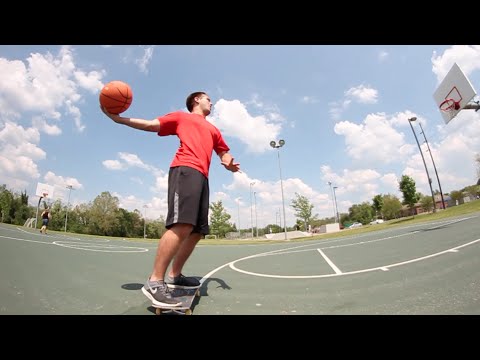
Watch a skateboarder for five minutes
They fall constantly. On purpose, almost. They pick a trick that’s clearly too hard, throw themselves at it, slam into the ground, get up, and do it again. Nobody’s making them. There’s no coach yelling. They just keep feeding themselves failure because somewhere in there they understand that landing it eventually is worth eating concrete a hundred times now.
Now watch most basketball players practice. They run the drills they’re already good at. They take the shots they already make. They avoid the stuff that makes them look bad, especially if anyone’s watching. And then they wonder why month six looks a lot like month one.
The skateboarder is addicted to the edge of their ability. The average player is allergic to it. That’s the whole difference, and it shows up on the court faster than any drill ever will.
The number nobody wants to hear
Here’s where it gets uncomfortable, because there’s actual science on this and the result is annoying.
Researchers looked at how much you should be failing during practice to learn the fastest. Not how it feels. What actually produces the most improvement. The evidence points to an optimal error rate of around 30 percent. You learn fastest when you’re missing roughly a third of the time, not when you’re succeeding constantly.
Sit with that. If you’re in the gym making almost everything, you are not in the zone where learning happens. You’re rehearsing. The reason is simple: to actually improve at a skill, you have to train at a difficulty that’s challenging but still doable, which means experiencing both success and failure, not just success.
So that great practice you had where you couldn’t miss? Be honest about what it was. It felt amazing. It taught you very little. If you only ever experience success, there’s nothing for your system to learn from, because there’s no error to correct. You made it too easy and your brain quietly clocked out around rep ten.
I’ll be straight that the research isn’t unanimous, there’s a case for keeping errors low when a skill is brand new. But for the vast majority of players who already know how to play and are trying to get better, the problem is never that practice is too hard. It’s that it’s too comfortable.
[image: split visual, one player coasting through layup lines, one player struggling through a hard finishing drill]
What it looks like at the top
I trained a college player, a genuinely high-level guy, and watching him work reframed what “talented” even means to me.
He’d miss a shot in a drill and there was just nothing. No flinch, no muttering, no little look at the rim like it had betrayed him. The miss was information and he moved to the next one. When I’d suggest a change, he didn’t argue and he didn’t get that defensive face players make when you imply they’re not already perfect. He tried it. Then he wanted to know why it worked, so he could use the reasoning himself later.
That guy plays professionally now. And I want to be clear about the order of operations there, because it’s the part people get backwards. He wasn’t open to coaching because he was good. He got good because he was open to coaching. The mindset came first. The talent compounded on top of it.
You see the same thing in players you’ve actually heard of. Steph Curry is the obvious one. His trainers describe pushing him to the edge of his limits on purpose, and Curry himself credits embracing that discomfort as the thing that kept him improving. He runs drills built specifically to overload his brain past what it can handle. Think about that. The best shooter who has ever lived spends his time looking for ways to make himself worse at things, temporarily, on purpose. He practices like the new girl who wouldn’t let me make it easier. That is not a coincidence, and it should probably tell you something.
The other kind of player
I’ve also worked with the opposite, and it’s worth being honest about because it’s far more common.
I had a middle schooler who could not survive a single miss. One brick and the body language collapsed. He’d argue with nearly every correction I gave, and on the rough days he’d actually end up in tears over it. We spent more of each session managing the meltdown than building any actual skill.
Here’s the thing I need you to hear: his problem was never talent. I genuinely never found out how good he could’ve been, because we never got past the part where a mistake felt like a personal insult. You cannot build a jump shot on top of that. The mindset is the foundation, and if the foundation can’t tolerate failure, nothing you stack on it holds. He didn’t last long, and that’s the honest outcome.
The good news, and I mean this, is that this part is fixable. I had another player who struggled with the exact same thing for a long time. I’d point it out and it wouldn’t land. Then one session he was working alongside a friend he trusted, felt safe enough to actually look at his own reactions, and just started laughing at how ridiculous they were. That was the turn. Once he could laugh at a miss instead of being wounded by it, his progress went vertical. He went from getting outplayed by kids younger than him to the best player in his group. Same body, same drills, just a completely different relationship with failure.
So how do you actually train this
Stop optimizing for makes. Makes feel good and a scoreboard full of them tells you almost nothing about whether you got better.
Pick the thing slightly past your reach. The finish you can’t quite hit, the move that falls apart at game speed, the shot off the dribble that betrays you when you’re tired. Set it up as hard and as realistic as you can stand, and then go at it like the skateboarder. Miss, reset, go again. Aim to be missing enough that it’s a little frustrating, because that frustration is the actual sensation of learning, not a sign it’s going wrong.
And nobody wants to do this with an audience, which is exactly why most players don’t. It’s a lot more fun to be the guy splashing warmup threes while people watch than the guy bricking a move he hasn’t earned yet. Pick the bricks. The warmup threes aren’t doing anything for you anyway.
Pay attention to the voice in your head when you miss, too. That voice is the real opponent. The player who can hear “missed again” and stay calm and curious is the player who’s going to look like a different human in two years. The one who hears it as proof they’re not good enough is going to spend those same two years protecting their ego instead of building a game.
The new girl, six months in, went from never having played to earning real minutes. Not because she was gifted. Because while everyone else was busy making easy shots and feeling great about it, she was over in the corner missing hard ones on purpose, like a skateboarder who hadn’t yet been told that falling was supposed to be embarrassing.
Be more like that.
Work With Me