
If an exercise feels impossible, you’re probably reading the wrong signal.
I had a client who could not do single leg hip thrusts without her hamstring trying to leave her body. A few reps in, the thing would seize up into a full charley horse, except in her Boston accent it was a “chaaalie hawse,” delivered with the kind of outrage usually reserved for parking tickets. She was certain, fully certain, that ten reps was impossible. Not hard. Impossible. Somewhere in the same category as her dunking.
So we kept at it. And here’s what actually happened, the part I held back from the newsletter. After a few weeks, she could carry on a conversation with me in the middle of a set. Telling me about her weekend, complaining about her son in law, the whole thing, mid hip thrust. The hamstring still tightened up. It still wasn’t comfortable. But somewhere along the way she’d quietly proven that the discomfort and the impossibility were two completely different things that she’d been treating as the same.
She was never confusing hard with easy. She knew it was hard. What she’d done was quietly file “hard” and “impossible” in the same drawer, and once we pulled those apart we kept adding reps and then weight, and she kept hitting numbers she’d have bet money she couldn’t touch.
That mix up is the whole article. Let me explain why it happens to basically everyone.
Some Exercises Start You at the Top of the Staircase
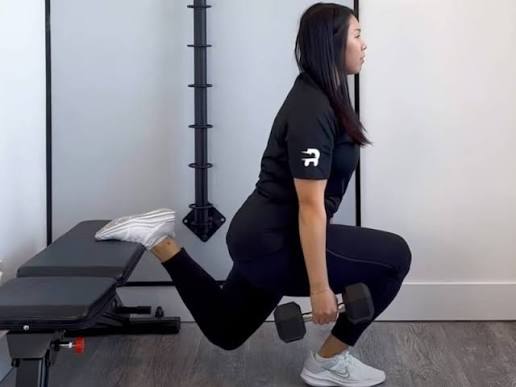
There’s a specific group of exercises that feel brutal almost regardless of how strong you are. Split squats, especially the rear foot elevated kind. Single leg RDLs. Pistol squats. Hip thrusts. Push ups and pull ups. Then the core stuff, hollow holds, deadbugs, leg raises, all of it.
Notice what most of those have in common. There’s no weight on the bar. People assume “no external load” means “easy,” which is one of the great misunderstandings of training. The difficulty isn’t coming from a dumbbell. It’s coming from the position the movement puts you in.
Take single leg work. The reason a Bulgarian split squat humbles people who can back squat a respectable number is not a strength problem. Research on single leg training points to the obvious culprit: standing on one leg gives you a much smaller base of support, so your body has to make a constant stream of tiny corrections just to keep you upright over that one foot. That’s balance, proprioception, and ankle and hip stability all getting taxed at once, on top of the actual leg strength. Strength coaches and sports medicine groups describe true single leg squats as legitimately advanced for exactly that reason, because they demand stability that most people simply haven’t built yet.
So when a split squat feels like punishment, you’re not weak. You got dropped into a movement whose starting point is already partway up the difficulty curve, and then it has the nerve to act like that’s the ground floor you should be comfortable standing on.
Bodyweight upper body and core work do the same thing in a different way. A push up isn’t “easier than bench press.” It’s a moving plank where you happen to be pressing. A hollow hold looks like lying down and yet somehow feels like your abs are filing a formal complaint. I’ve watched people who could press real weight get genuinely humbled by a strict push up on the floor, look up at me a little betrayed, and ask what’s wrong with them. Nothing’s wrong with them. The position is the load, and nobody ever told them that, so they showed up expecting the absence of a dumbbell to mean the absence of difficulty.
[Video suggestion: side by side of a rear foot elevated split squat and a regular goblet squat, just to show the stability difference]
Your Sense of “Hard” Keeps Moving
Here’s the part that messes with people once they do get stronger. The exercise still feels hard. So they conclude they haven’t improved, or that they’ve hit some permanent ceiling.
Your perception of difficulty is not a fixed gauge. It recalibrates. You come to expect a certain feeling from certain movements, and a hip thrust at 30 pounds heavier can feel about the same as it did months ago at bodyweight, because you got stronger and the demand went up to match. The feeling held steady while the actual capacity climbed underneath it. If you only trust the feeling, you’ll swear nothing changed, while your numbers tell a completely different story.
This is also the cleanest line I can draw between this and something I wrote a couple weeks back. I made the case that some exercises genuinely aren’t for you, that certain movements don’t fit your body and you should stop forcing them, and I stand by that. This is the opposite situation, and you have to be honest with yourself about which one you’re actually in. Sometimes an exercise is wrong for you. But a lot of the time it just feels hard, and “feels hard” quietly gets filed under “not for me” so you never have to find out what you could’ve done with it.
Hard Is a Feeling. Near Failure Is a Fact.
This is where it gets useful, and where the research is genuinely a little embarrassing for all of us.
When people are asked to call out how many reps they have left in the tank, they’re bad at it in one very specific and very expensive direction. In one study, well trained lifters, not beginners, were on average about five reps off when they reported where they were mid set. And the error went the wrong way. They thought they were close to done when they actually had somewhere around ten reps left. They felt finished. They were barely halfway.
Sit with that. Experienced lifters, people who train seriously, routinely believe they’re at the edge when they’ve got most of the set still in front of them. If they’re that far off, the rest of us guessing based on vibes are not doing better.
So how do you tell the difference between “this is hard” and “I’m actually near my limit”? You stop trusting the burn and you watch your rep speed. The research that built the whole reps in reserve system found a strong, reliable relationship between how fast you’re moving and how close you are to failure. As a set gets genuinely close to the end, your reps slow down in a measurable way, even when you’re trying to move at the same pace. And you don’t need a fancy velocity tracker for the everyday version of this. Just notice when a clean rep suddenly takes noticeably longer than the one before it. That slowdown is the honest signal.
Burning, shaking, the dramatic face, the charley horse noise? That’s effort. Effort is uncomfortable and it’s supposed to be, but discomfort shows up long before failure does, and most people slam on the brakes at the first sign of it and call that their limit. The good news buried in here is that you get better at reading it. Research shows the closer you train to actual failure, and the more sets you log over time, the more accurate your sense of “reps left” gets. You’re just bad at it until you’ve practiced it, same as anything else you’ve ever learned to feel.
The Client Who Was Sure She’d Lost Everything
Let me give you the other one, because it’s the flip side of the hip thrust client and it shook her up more than she expected.
I had a client who loved to load things. Heavy squats were her happy place, she was used to real weight on the bar, and her sense of “a hard set” was built entirely around that. Then she had a minor procedure on her upper back and needed a stretch where we couldn’t load her spine like that. So we backed off the bar and went to single leg squats to a box, with a slow tempo on the way down.
They wrecked her. Legs shaking, the whole bit, on what looked from the outside like a gentle bodyweight movement. And in her head the verdict was immediate and brutal: she’d gotten weak. All that strength, gone. Months of work, evaporated, apparently, over a couple weeks of modified training.
Except none of that happened. She hadn’t lost a thing. She’d been moved into a movement with a massively higher stability demand than the one her confidence was built on, and the two aren’t comparable. A heavy bilateral squat and a slow tempo single leg squat to a box are not the same test, so the fact that one humbled her told her nothing about whether she’d lost the other. Her body was fine. Her measuring stick was just wrong for the exercise in front of her.
The fix was mostly explaining that. Once she understood why the box squats were frying her, that it was a stability challenge she’d never trained, not some collapse of everything she’d built, she bought back in. We added reps. Then we added a little weight. She made real progress in a stretch where she’d assumed progress was off the table, and honestly the happiest I saw her in that whole block was the day she got properly sore again and texted me about it like she’d found a twenty in an old coat.
[Photo suggestion: client mid set on a box squat, focused, clearly working]
So What Do You Actually Do About It
Stop using “this feels hard” as your stopping signal. It’s the least reliable instrument you own.
When an exercise feels too hard at the entry point, that’s not a verdict on you, it’s information about where that movement starts. Regress it. Hold the wall for the split squat. Put the push up on an incline. Bend the knee on the single leg RDL. Get a version where you can own the position, then climb. The goal was never to white knuckle the hardest variation on day one and prove something. The goal is to get strong enough that the hard version becomes your version.
And when something still feels hard after you’ve gotten stronger, good. It’s supposed to. That doesn’t mean you’re maxed out, it means you’re still being challenged, which is the entire point of showing up. So watch your rep speed instead of your discomfort. Push two reps past where you’d normally quit and see whether your body actually slows down or whether that was just your brain doing PR for your comfort zone. Usually it’s the second one, and the wall you’ve been stopping at turns out to be painted on.
The hip thrust client found out she could chat through a set she’d called impossible. The squat client found out she was never weak, just measuring with the wrong ruler. You’ve almost certainly got one of these in your own training right now, an exercise you’ve quietly decided is your ceiling.
It’s probably a fence you could’ve stepped over months ago.