
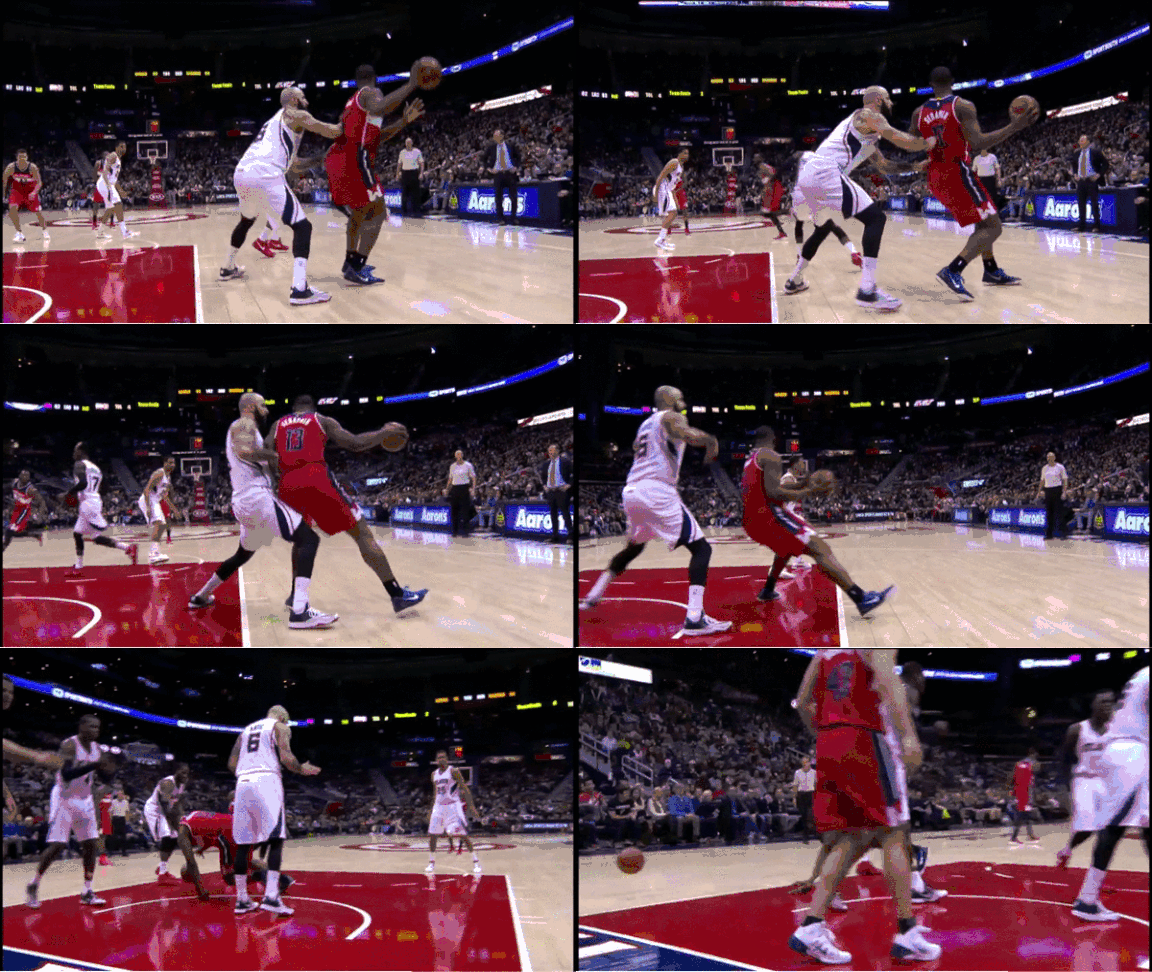
I had a middle school kid who could shoot the lights out from the perimeter. Catch and shoot, money every time. But the second he put the ball on the floor to drive, he got stuck. The defender would stay glued to him, he’d pick up his dribble, and then he’d just stand there holding it like a hot dish with nowhere to set it down.
His fix, in his head, was always speed. Get faster, blow by the guy, done. So he’d try to win a footrace, lose the footrace, and end up exactly where he started. Stuck, and now winded.
He didn’t need to be faster. He needed to learn how to push and pull.
The Thing Nobody Teaches
Most young players think scoring against a defender is about getting past him. Beat him off the dribble, turn the corner, gone. And sure, sometimes you’ve got a speed advantage and you can just go. But the second you play someone as fast as you, or faster, the footrace stops working. Then what?
Then you have to take control of the defender instead of running from him. And the way you do that is with contact.
Here’s the mindset shift. A defender isn’t a wall you have to run around. He’s a door. If you lean on him the right way, he opens, and he opens into exactly the space you want. But you only get that if you’re actually touching him. You can’t move something you’re not in contact with.
[Image suggestion: a player with forearm or shoulder contact into a defender on the drive, showing the lean, captioned something like “contact is control”]
So step one is the push. Initiate the contact. Get a forearm, a shoulder, a hip into him. Not a foul, not a bulldoze, just enough that you can feel where his weight is and he can feel yours. The moment you make contact, something changes. Now you’re the one applying pressure, and he’s the one reacting. You’re driving. He’s a passenger.
Why the Push Is Only Half of It
Here’s where most kids stop, and it’s why “be more physical” is incomplete advice. They learn to initiate contact, they get excited about it, and then they just bury their shoulder into the defender and try to drive through him. Now they’re out of control, traveling, charging, or throwing up a prayer while falling sideways. Being physical without a plan is just fouling with extra steps.
Contact is not the move. Contact sets up the move. The move is what you do after you feel him react.
Because here’s what happens when you push into a defender: he pushes back. He has to. If he doesn’t brace against you, you drive right through him, and he knows it. So he leans in to hold his ground.
And that lean is the gift. The instant he’s pressing into you, his weight is committed. He’s depending on you being there to hold him up. So you take yourself away. You pull off the contact, you separate, and all that weight he was leaning on you with suddenly has nowhere to go. He’s off balance, you’re not, and now there’s a gap where his body used to be.
[Image suggestion: two-panel. Panel one, player pushing into a braced defender. Panel two, player separating off as the defender stumbles forward into the vacated space]
That’s the pull. The push earns it, but the pull is where the space actually shows up.
It’s a Rhythm, Not a Shove
The part that takes the longest to learn is that this isn’t one push and one pull. It’s a back-and-forth. A conversation with the defender’s balance.
You push, he braces. You ease off a little, he relaxes. You push again, he braces harder. Somewhere in that exchange, he over-commits. He leans too hard, or he relaxes at the wrong moment, and that’s your window to either pull off for the shot or attack the space he just gave up. The best scorers aren’t doing one big move. They’re constantly changing the pressure, reading the lean, and waiting for the defender to make the mistake.
It’s the same logic as changing speeds. Fast then slow, slow then fast, keeps a defender from ever settling. Push and pull is that exact idea, just with your body and contact instead of your dribble and your feet. You’re never giving him a steady thing to balance against, so he’s always a half-second behind.
[Video suggestion: side angle of a player initiating contact on the drive, the defender bracing into him, then the player separating off the contact into a clean pull-up, slowed down to show the lean and the release]
What This Looks Like in My Gym
The middle schooler from the top of this article got it eventually, and it changed his whole offensive game. We didn’t make him faster. We taught him to drive into the defender’s hip, feel for the lean, and learn the timing of when to release pressure and slide off into his space. We worked the kind of pull-up Devin Booker lives on, where you ride the defender, feel him commit, and then peel off into a clean look. Suddenly he didn’t need to beat anybody. He just needed a step, and a step is cheap once you know how to take it.
Then there’s a high school girl I work with who had the same hole, flipped. She could score, but only when she was already open. The second a defender got into her body or a help defender stepped up, she had no answer, because she’d never learned to push. She wasn’t slow. She just didn’t know she was allowed to make contact, so she’d avoid it and float to a spot and hope. We had to teach her the first half of the equation, how to initiate, how to get into a defender and make them deal with her, before the separating even mattered. Once she had the push, the pull came fast.
And my favorite example is a younger kid who is not, by any measure, the fastest guy out there. He runs like he’s got a piano on his back. But he plays like a mini Jokic, because he figured out the timing of giving and releasing pressure way earlier than his peers. While everyone else is trying to win footraces, he’s leaning guys to sleep and stepping into space they handed him. He’s miles ahead of kids who are way more athletic, purely because he understands this one thing. Athleticism is loud. Timing is quiet. Timing wins more than people think.
How the Pros Show It
You don’t have to take my word for it. Watch the best guards in the league and this is most of what they do.
Shai Gilgeous-Alexander won MVP this past season, and if you watch him, he barely sprints anywhere. He decelerates into defenders, pins them on his hip, and waits for them to commit before slipping into the gap. It’s push and pull at an absurd level of control.
Jalen Brunson is listed at six feet, which is generous, and he is not blowing by NBA athletes. He gets into their body, leans, feels, and creates his own space against players far longer and faster than him. He is the patron saint of “you don’t have to be the biggest or fastest.”
And Luka Doncic led the entire NBA in scoring while looking like he’s moving in slow motion. He changes pace, leans defenders off balance, and gets to his spot every time, not because he’s quick, but because he’s never giving the defender a steady thing to guard.
[Image suggestion: a current still of SGA or Brunson decelerating into a defender on the hip, if you’ve got a usable one]
None of these guys win footraces. They win the contact, then they win the timing.
How to Start
You don’t need to be strong to do this. You need to be willing to make contact and patient enough to read what comes back. Start here.
Get into a defender on the drive instead of avoiding them. Feel for their weight. When they lean into you, that’s your cue to separate, not to push harder. Practice the rhythm slow at first, push, feel, pull, until you can feel the moment their balance tips. Then speed it up.
And play the push/pull game in the drill up top, because nothing teaches this faster than a defender who’s allowed to lean on you and a rule that says you only score from the space you made.
The fastest kid on the court is going to be a problem for a few years. Then everybody catches up, and the kid who learned to push and pull is the one still getting buckets. Speed expires. This doesn’t.