
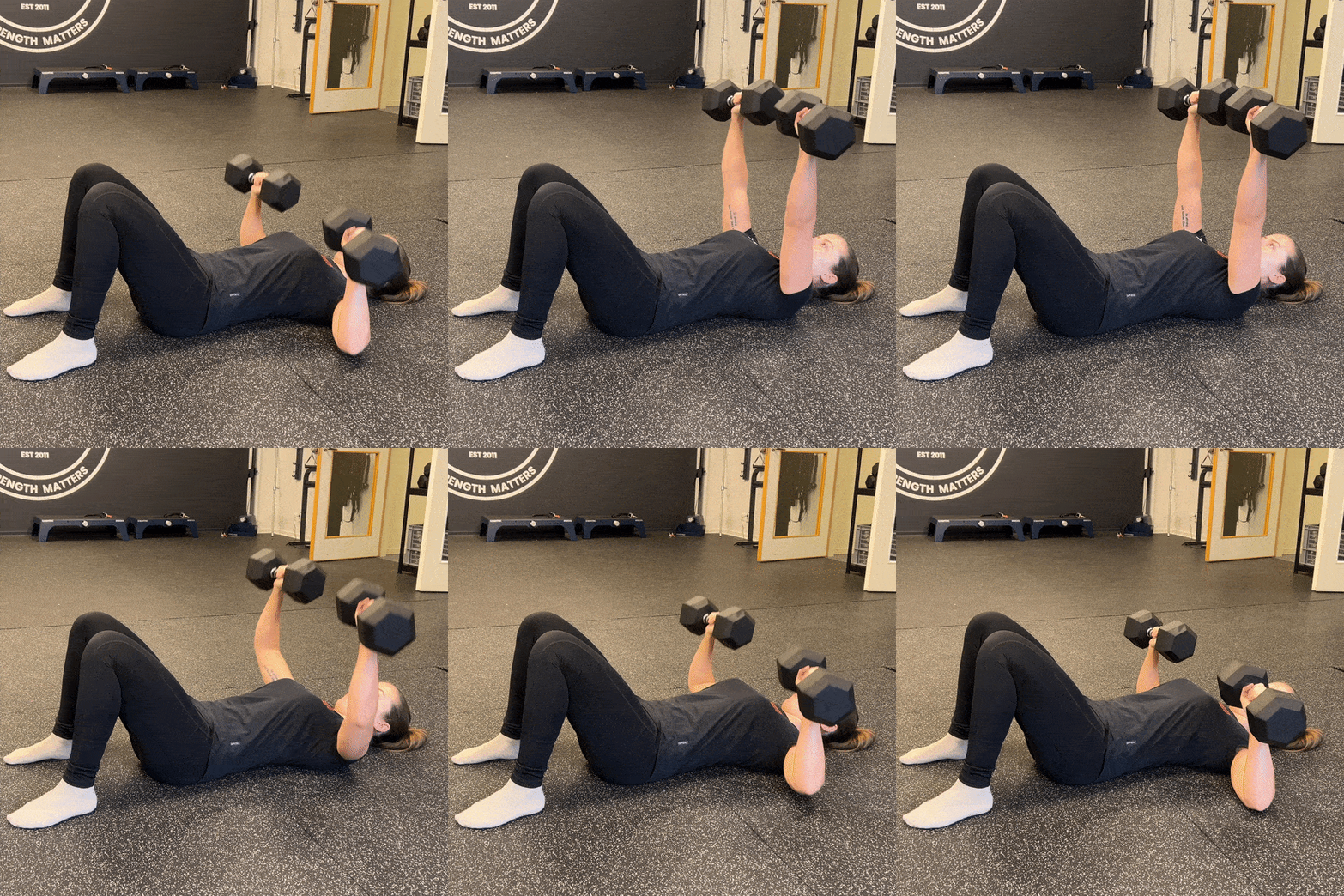
I had a client, an older woman, whose shoulders did not want to cooperate. We’d been working on her mobility for a while and making real progress, and she was fired up about it. She wanted to push. Add weight, chase the burn, actually feel like she was training instead of doing physical therapy homework.
So I put her on the floor and had her press there. Range cut short. Stopping before the bottom of the press, the exact spot where her shoulder would’ve had to rotate into a position it didn’t have yet.
You could read it on her face. She thought I was babying her. She’s ready to load it up and the coach has her doing half a press. Where’s the rest of it.
I wasn’t making it easier. I was making it doable. Those are two different things, and almost everybody mixes them up.
The Two Reasons People Cut a Range, and Only One Is Good
Let’s clear this up first, because I know how it sounds.
There’s a version of short-range training that’s just laziness with better branding. Somebody quarter-squats a big number so they never have to feel the bottom. Somebody benches three inches so the weight stays impressive. That’s cutting the range to dodge the hard part and protect the ego. Not what I’m talking about.
Then there’s the version I’m talking about, which is the opposite. You cut the range because the part you’re skipping is the part your joint can’t get to yet. Not won’t. Can’t. And it doesn’t have to be screaming pain. Maybe it just feels stiff, or achy, or like something in there catches at a certain spot. That’s your body telling you that range isn’t yours right now.
Here’s the trap. Most people only know two answers to that signal. Grind through it, or quit the movement. Both are wrong, and the right answer is sitting right between them, ignored.
You Can Push Hard Without Going to the End
Back to my shoulder client. The full press needed shoulder internal rotation she didn’t have access to yet, so forcing it would’ve just meant cranking on a joint that wasn’t ready and calling it toughness. Instead we kept her on floor presses and similar variations, where the floor stops the movement before the cranky range and the shoulder never has to go where it can’t.
And we still hammered her chest, shoulders, and triceps. We loaded it up. She worked hard. She just worked in the range she owned instead of the one she didn’t.
Then the range showed up. Her internal rotation improved, we let the press get longer, and she got the full thing back.
This is the part that catches people off guard, so stay with me. The shortened version wasn’t a stalling tactic while we waited around for mobility to magically appear. The loaded work was part of what built the mobility. Research on resistance training keeps finding that lifting through whatever range you’ve got improves your range of motion about as well as stretching does, and in people who start out stiff, sometimes better. The waiting room was the appointment.
There’s a catch worth knowing. That same research found bodyweight-only work didn’t move the needle much on range. So this isn’t “do easy air-pressing and hope.” It’s load, through a range you control, with intent.
And if you’re worried you’re leaving gains on the table by going short, don’t be. When you stack partial range against full range for building muscle and strength, they come out close to even. You are not getting a worse workout. You’re getting the workout your body can actually use today.
[Video suggestion: side by side of a full barbell press where the shoulder cranks at the bottom vs. a clean floor press stopping short, to show the range we’re protecting]
The Guy Who Was Sure His Back Was Just Like That Now
I had a guy who couldn’t deadlift without his back making him regret it the next day. He’d more or less accepted it. Figured this was the deal now, that picking heavy things off the floor was simply something his body had filed under “no.”
His problem wasn’t toughness and it wasn’t his back being broken. It was his hips. He didn’t have the internal rotation to fold down to a bar on the floor cleanly, so to reach it he’d compensate, and the compensation is what his back paid for. The bar being on the floor was the issue. So I raised the floor.
We pulled from blocks, bringing the bar up to a height his hips could actually reach without the back taking over. We put wedges under his heels, which for his particular hips made the bottom position something he could control. None of this is one-size-fits-all, the heel thing depends entirely on what’s going on with you, but for him it worked. We taught the hinge in a position he could own, strengthened all the muscles that pick a thing up, and chipped away at his hip internal rotation on the side.
[Image suggestion: the same lifter pulling from blocks at about knee height with heels slightly elevated, showing a flat back, next to a floor pull where the back rounds to reach the bar]
Over time the range came in, we lowered the bar back toward the floor, and the thing he’d decided his body just couldn’t do turned out to be a thing his body couldn’t do from that exact height, that exact way. Different setup, different story.
The Guy Who Said “It’s Fine”
Then there’s the client whose shoulder was bugging him and who absolutely did not want to deal with it. “It’s fine. I’ll work through it.” For months. You know the type. You might be the type.
It was not fine. When we finally stopped pretending and looked, his rows were the worst offender, and the limitation was in his shoulder’s external rotation and how much room his upper back had to move. Every time he rowed and yanked the shoulder blades back hard, he was driving into a range that wasn’t there.
So we changed what kind of pulling he did. We backed off the heavy retraction rows, the ones demanding all that squeeze, and shifted toward more lat-focused pulling where the shoulder blade gets to rotate up and down naturally instead of getting forced back. Same muscles trained. Different demand on the cranky part. Meanwhile we worked on opening up his upper back so the shoulder had somewhere to go.
After a while, and this is the dream, he stopped having to think about it at all. The shoulder just stopped being a topic. Helped that he also finally eased off whatever he was doing out in the yard that kept re-aggravating it, because all the smart programming in the world loses to a guy who goes home and undoes it with a rake.
How to Tell Which Range Is Yours
So how do you actually use this on yourself. You don’t need a movement screen and a clipboard. You need to pay attention, which most people skip.
Take the movement that’s been nagging you. Press, row, squat, hinge, whatever lights up the same spot every time or just feels stuck. Find the point in the range where the pinch or the ache or the stiffness starts. That point is your current edge. Work up to it, not through it.
[Image suggestion: a simple two-panel showing a press stopping just shy of the cranky bottom range, with a marker on where the “clean range” ends]
Then, and this is the part people forget, check back. After your session and over the next few weeks, watch that joint. If it feels the same or better, you’re in the right range, keep training there and keep loading it. If it’s getting worse, that range is still too much for now and you back off further, or you find a different variation entirely. Your body’s giving you data the whole time. You just have to actually read it instead of either bulldozing past it or running from it.
And put a little stretching or mobility work in for that joint on the side, so the room keeps opening while you train.
That’s the whole thing. Not push through it. Not give it up. Push where you are, watch for the range to come, and load the daylights out of the territory you already own while you wait for the rest of the map.
Your body isn’t refusing you. It’s just telling you where the line is today. The line moves.