
Stop Chasing the Perfect Version. Do the One You'll Actually Repeat.
I train a woman who became a grandmother a few months ago, and her hips have been giving her a rough time. She is exactly the kind of person who needs a little daily mobility work. She also could not make it happen to save her life. Her daughter had a baby, her schedule got swallowed whole, and she was already scrapping just to get to our strength sessions. Asking her to tack on ten more minutes of hip work at home felt about as realistic as asking her to pick up a second job.
For a while I assumed it was a time problem. It wasn’t. She had the time. What she didn’t have was a version of the drill she could actually see herself doing. Every time she pictured it, she pictured the ideal: quiet room, mat down, phone away, ten focused minutes of intentional movement. That version is lovely. That version also never happened once, because it does not exist in the real life of a woman helping raise a newborn.
This is the trap I watch smart, motivated people fall into constantly. They decide the only version worth doing is the best one, and then they do nothing.
The optimal plan is worthless if you won’t run it
There’s a stubborn belief floating around that if something isn’t the most effective possible option, it’s basically a waste of time. That you have to pick the hardest, most optimized version and suffer through it, and anything easier is cheating yourself.
I think that’s exactly backwards, and the research agrees. Studies on exercise enjoyment keep landing on the same finding: how much you actually like a form of movement is one of the strongest predictors of whether you’ll still be doing it months and years down the line. Not how many calories it burns on paper. Not how it ranks on some optimal-training chart. Whether the experience of doing it makes you want to come back.
That flips the whole priority list. The single most important quality of any health habit is that you’ll repeat it. Effectiveness comes second, because you can always sharpen a habit you’re already doing. You can add reps, add intensity, clean up the technique. What you cannot do is optimize a habit you quit in the second week. A mediocre thing you’ll do fifty times beats a perfect thing you’ll do twice and then resent.
Nobody likes the whole menu
Here’s the honest picture of health. There’s a short list of things almost everyone agrees are good for you: some cardio, some strength training, mobility and stretching, decent sleep, enough water, fruits and vegetables, enough protein, and general daily movement like walking. That’s most of it.
Almost nobody enjoys all of it. Most people have at least one item on that list they will actively route their whole day around avoiding. Some people, and I say this with love, dislike the entire menu. That’s fine. The goal was never to become someone who loves broccoli and burpees. The goal is to find the one tolerable version of the thing you’re avoiding and build from there.
What actually worked, three times
The grandma and the show intro
Back to my new grandma. Instead of fighting for a perfect ten-minute mobility block that was never coming, we looked at what she already did every single night without fail. And every night, she watched her shows. Two hours of streaming, guaranteed, no willpower required.
So that became the anchor. Before she let herself sink into the couch for the night, the moment the show’s intro started rolling, she’d start her hip drills right there. She’d keep going through the opening few minutes of the episode, then settle in. No mat, no quiet room, no separate block of time carved out of a day that didn’t have any to spare.
It worked because it removed the friction instead of adding more of it. Behavior research is blunt about this: small barriers quietly kill habits, and the easier and more obvious you make a behavior, the more likely it sticks. She wasn’t relying on motivation anymore. She was riding a routine that already existed. The bonus she didn’t expect was that she stopped feeling guilty about the two hours of TV, because now that time came with a side of taking care of her hips.
[Photo: simple hip mobility drill being done in a living room, TV glowing in the background]
The retiree who accidentally found cardio
I’ve got another client, a guy staring down retirement and pretty thrilled about it, whose kids are grown and out of the house. He wanted a hobby that kept him at least a little active. He genuinely loves our private sessions and the big group classes, so strength was covered. Cardio was the black hole. He had tried every machine in the building and hated all of them with a rare purity. The pool would’ve worked except getting in and out of it annoyed him enough that it was never going to last.
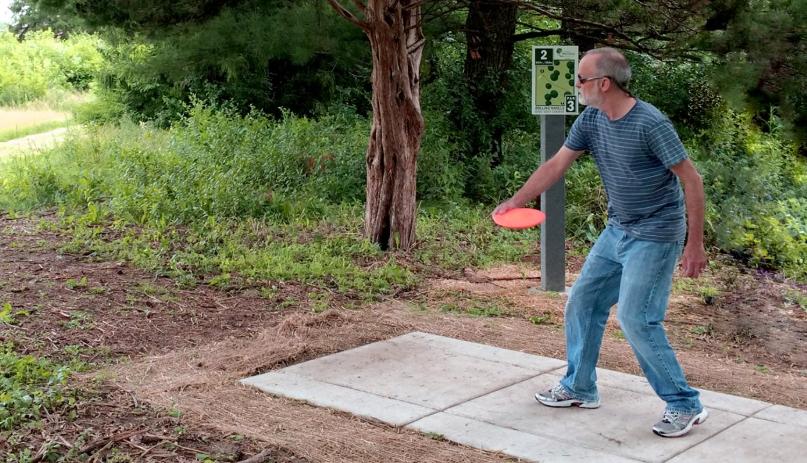
Then he stumbled onto disc golf. He’d seen it around for years and always assumed it didn’t count as real exercise, just walking around throwing a frisbee. Turns out a lot of the courses play like a light hike, and now he’s outside covering real distance without once thinking of it as cardio. His “workout” is a hobby he looks forward to. We still have to solve the winter version, because New England has opinions about outdoor anything from December to March. But a win is a win, and I’ll take a guy who does disc golf eight months a year over a guy who does zero months of the elliptical.
[Photo: a disc golf basket on a wooded course, or a client mid-throw on a fairway]
The former athlete who thought Pilates was the whole answer
Last one. I train a younger woman who jumped on the Pilates train and figured that would cover all her bases. She’d been an athlete in college and missed those days badly. Back then she never thought about working out, because sport was just baked into her life. She assumed Pilates would hand all of that back.
A few weeks in she was sore constantly but didn’t feel any stronger, and she was right, because she wasn’t. Her old training was never really about building strength and muscle. It was HIIT, the kind of conditioning that made her want to throw up every session, which apparently is how you get good at lacrosse. So when she tried actual strength work with me, her body braced for that same nauseous grind, and she hated it.
Making her tolerate real strength training took two things, and neither was more discipline. First, I started dropping little challenges into the workout, small targets to hit within a set. She got hooked on the end of each session, when the app would congratulate her on more total volume or flag a new personal record. That little hit of “you did more than last time” gave her a reason to look forward to the work. Second, and I’m only half joking, the rest periods became a place to vent about annoying coworkers. Between the small wins and having a space to decompress, the dread faded and the nausea went with it.
It was one day a week for a long time. That was the whole program, and it was enough, because it was consistent. Eventually she started adding a couple of short sessions at her own gym. Over a year later, strength training is just part of who she is now. It stopped being a thing she forces and became a thing she does.
[Photo: a client mid-set on a strength lift, or a phone showing an app’s PR / volume screen]
How to find your own version
Pick your worst-hated healthy thing and make it small, obvious, and honestly kind of fun. Start by breaking the goal down to its most basic reason for existing. The point of eating vegetables isn’t to eat vegetables. It’s to get more fiber and nutrients into your week. So the move isn’t to meal prep six sad containers of steamed broccoli you’ll be avoiding by Wednesday. It might be grabbing lunch with a coworker at the salad spot or the grain bowl place, where you get the fiber, the nutrients, and some decent company, and none of it feels like a chore.
[Photo: a colorful salad or grain bowl on a table, casual lunch setting]
Hate cardio? Don’t force yourself onto a machine you loathe. Find the walk, the hike, the disc golf course, the friend who talks enough that you forget you’re moving. Can’t fit mobility in? Staple it to something you already do without thinking, the way my grandma stapled hers to her nightly shows.
Pick a version you can genuinely picture yourself doing tomorrow, not the heroic version you’ll admire from a distance and never touch. Get consistent first. You can always make it better once it’s actually happening.
The perfect plan you abandon in February does nothing for you. The imperfect one you’re still doing next winter changes your whole life.